Showing posts with label administrative detention. Show all posts

Thursday, April 19, 2012

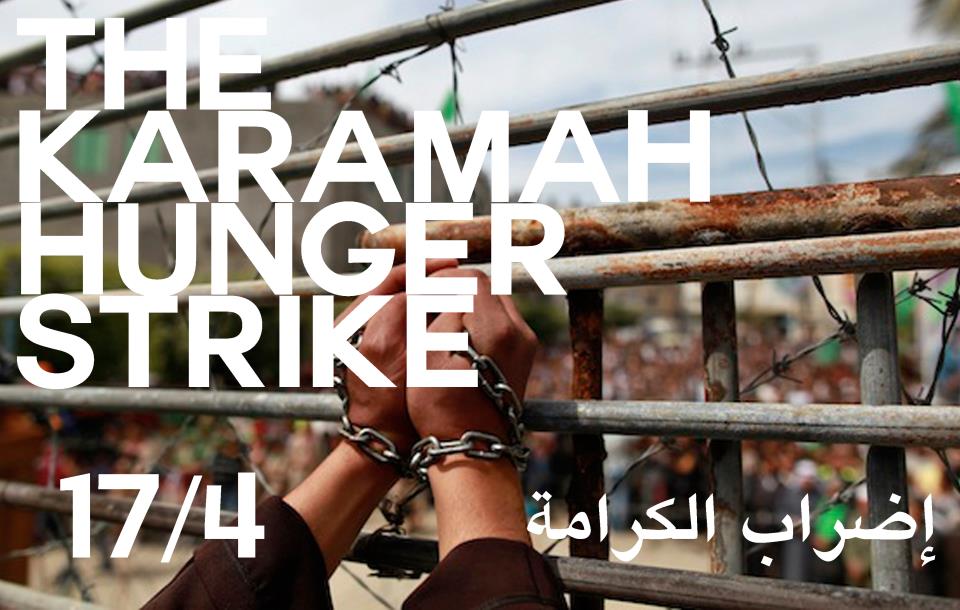
Hunger striking prisoners facing sharp repression and continue their demands

Samidoun

Palestinian prisoners on hunger strike are facing sharp repression from the Israeli Prison Administration. As reported by Addameer and others, Palestinian prisoners on hunger strike have reported confiscation of personal items and warm clothes. In response to these attacks, prisoners in Nafha are threatening to begin to refuse water as well.
One group of Palestinian prisoners associated with the Popular Front for the Liberation of Palestine at Eshel prison participating in the strike have been transfered to Ohalei Kedar prison in retribution, while Hamas prisoners at Eshel prison on hunger strike were separated from one another and moved into the rooms of Fateh prisoners, in an attempt to exacerbate factional tensions.
At Ramon prison, Palestinian hunger strikers have been moved into isolation cells and hunger strikers throughout Israeli prisons are being denied access to independent doctors. Addameer lawyer Samer Sama’an has been banned from visiting all prisoners from 6 months, the second time in recent months that such a ban has been applied to an Addameer lawyer during prison hunger strikes.
In response to these attacks, Palestinian prisoners on hunger strike issued another statement reiterating their demands:
Despite the threat of the executioner, and the strength of his weapons, we will
1 – end the policy of solitary confinement
2 – close the file of administrative detention
3 – Cancel the actions taken after the capture of Shalit and the most important of which prevent the prisoners of Gaza Strip’s (456) prisoners from visiting their parents
4 – Allow higher education.
On Prisoner’s Day, this will not be just another day of another year. Therefore, they are preparing to confront the torturers, the executioners, and their weapons, and despite the failure of the international community, we stand armed with only our empty stomachs and solid will derived from the heroic march of our people who continue to resist, and we have faith in victory and the justice of our struggle for freedom.

Wednesday, April 18, 2012

Adnan: Crowd's joy made me forget all suffering


BETHLEHEM (Ma’an) -- “The happiness I saw on my peoples’ faces made me forget all the suffering I experienced when I was on hunger strike,” freed Palestinian prisoner Khader Adnan said Wednesday.

When he arrived in Jenin, instead of going home, Adnan chose to head to the sit-in tent in Arraba village to meet with parents of prisoner Jaafar Izz Addin who is now on hunger strike protesting Israeli policies against prisoners.

Hundreds of Palestinians gathered on Tuesday night to greet the former detainee, whose 66-day hunger strike inspired others to protest administrative detention.

Adnan proceeded to visit the al-Aridha family who have three brothers in Israeli jails. Amjad al-Aridha is serving a 20-year sentence, his brother Mahmoud is serving life sentence, and Raddad al-Aridha is also detained in Israeli jail.

As time ran out, Adnan insisted on visiting the sit-in tent in Kafr Raai village after midnight to meet with the mother of prisoner Bilal Thiab who has been on hunger strike for more than 50 days.

He arrived at 3 a.m. and told Thiab's mother that when her son bid him farewell he was chanting “Allahu akbar”. Other prisoners Thaer Halhla, Hasan Safadi, Omar Shallala and Mahmoud Siksik also chanted “Allahu Akbar” from inside their prison cells because they were not allowed to bid him farewell, Adnan explained.

Asked about the last moments before he left his cell in Ramla prison for freedom, Adnan said, “It looked like an uprising as all my hunger-striking fellow prisoners began chanting 'Allahu akbar.'

"I tried to bid them farewell," he added, "but I was denied that and was moved from one detention center to another until I finally arrived at Salem center in the northern West Bank.”

Adnan highlighted that his release was delayed 16 hours as he was moved from one place to another. He was not released from Salem center, but was handed to the International Committee of the Red Cross which took him to Arraba.

“When I noted that delay, I started a hunger strike again fearing the Israelis might go back on their word.”

“They detained me in the darkness so that nobody could see them, and when they released me they did it in the darkness so that nobody could welcome me. They failed in that because I had a reception which indicates that our people are still committed to the prisoners' cause and will support them until they are all freed,” Adnan said.

Adnan pointed out that Israeli prison authorities shut down the windows of all cells when they moved him to prevent other inmates from seeing him released.

With regard to the feasibility of hunger strikes, Adnan said it would be better if it is done in stages starting first with dozens or hundreds of prisoners, then gradually others join them until all prisoners are on hunger strike. The longer prisoners continue with hunger strike, the better they can expose the occupation’s policies and injustice to the world, he said.

As for the current situation with 1,600 prisoners on hunger strike, Adnan suggested that other prisoners join them in stages with 500 joining at each stage.

“My hunger strike was not a new form of hunger strike, but the long duration gave it special importance. This is like vertical expansion where you construct a building on a small area of land, but that building benefits everybody.”

Israel frees Khader Adnan


Khader Adnan's 66-day hunger strike inspired hundreds of prisoners to take
on Israel's policy of holding detainees without charge.

BETHLEHEM (Ma'an) -- Israeli authorities released former hunger-striking administrative detainee Khader Adnan late Tuesday, a Ma'an correspondent reported.

Adnan arrived at his home in Araba in the northern West Bank to meet his family before returning to a tent reception where he spoke to well-wishers and officials in the village.

Hundreds of Palestinians chanted slogans in solidarity with prisoners as they welcomed the former detainee, whose 66-day hunger strike inspired others to protest administrative detention.

Under the provision, Israel can imprison suspects indefinitely, without ever informing them of the charges they face or presenting their lawyers with any evidence. Over 300 Palestinians are held without charge in Israel.

Inspired by Adnan's protest, a female prisoner, Hana Shalabi, refused food for 43 days before the Israelis decided to deport her to Gaza, barring her from returning to her native West Bank for at least three years.

On Tuesday, at least 1,200 prisoners in Israeli jails launched an open-ended hunger strike.

Hundreds joined the so-called "battle of empty stomachs" to coincide with Palestinian Prisoners' Day, when both the occupied West Bank and Gaza Strip stage mass rallies in support of some 4,800 prisoners who are held in Israeli prisons.

The Israeli prisons' authority said 2,300 prisoners had announced they would reject their daily meal on Tuesday, while 1,200 indicated they were launching a formal hunger strike.

"The Israeli Prisons Authority has coped with hunger strikes in the past and is prepared to cope with it now," it added.

Palestinian officials said 1,600 prisoners were joining the indefinite hunger strike.

Human rights groups called on Tuesday for international accountability for the situation of Palestinian prisoners. Al-Mezan urged the international community not to work with security corporation G4S, which equips Israeli checkpoints and jails.

Meanwhile, al-Haq urged the world not to ignore four Palestinian hunger-strikers who have been hospitalized after refusing food for over a month.

Reuters contributed to this report.

Tuesday, April 17, 2012

Call for international action: Show your support on Palestinian Prisoners day

12 April 2012 | International Solidarity Movement

This week International Solidarity Movement is calling for international solidarity in the run up to Palestinian Prisoners Day on the 17th April.  The Palestinian prisoners struggle needs immediate international attention as Israel’s treatment of prisoners under a military judicial system starkly violates international law and fundamental human rights.  According to Addammer there are currently 4,637 Palestinian political prisoners are kept in Israeli military jails and detention centers, including 320 administrative detainees.
Some of the primary objectives of the prisoners struggle are:
  • To stop the system known as administrative detention, which allows the imprisonment of individuals without charge or trail
  • To halt the practice of solitary confinement.
  • To stop the use of torture and ill treatment. Palestinians are exposed to systematic ill and degrading treatment from the moment of arrest – both physiological and physical terrors are used as means of breaking the prisoners and getting details and information.
  • To stop the illegal transference of prisoners from the occupied territories into Israeli borders. Every time Israel brings a prisoner from the West bank jails inside their borders – they are in clear violation with the 4th Geneva Convention.
  • To stop the use of military courts for civilians.
  • To stop arrest and imprisonment of vulnerable groups such as children, elder and disabled.
Besides the suffering of individual prisoners, Israel systematically uses collective punishment towards the relatives of prisoners. The journeys to visit your husband, wife, son, or daughter may take up to 15 hours as the prisoners are systematically placed as far from their home as possible. Furthermore, visitors will face degrading processes of strip search at the borders to Israel and at the entrance to the prisons. Sometimes they even get turned away.
“All people and governments of conscience in the world have an immediate responsibility to put pressure on Israel forcing them to respect International law and human rights!” says Faris Sabbah, from Addammer, the Prisoners support and Human Rights Association.
TAKE ACTION
You can:
  • Organize a protest in front of the Israeli Embassy or consulate in our town
  • Write letters to protest the violations of rights of Palestinian political prisoners and to call for an intervention to the International Committee of the Red Cross, UN Secretary General Ban Ki-moon and your governoment or parliamentarians.
  • Write letters to Palestinian prisoners expressing your support. Read more about thise here:
Submit your photos:
What ever action you choose to take – please submit photos from your action to ISM at palreports@gmail.com.
You can get inspired from similar ISM campaign carried out in accordance to “Open Shuhada Street Campaign.”
Please follow these guidelines:
  1. In the subject line please write “ Campaign for international solidarity with Palestinian prisoners”
  2. Photos should not be a maximum of 1 MB
  3. A poster, sign, clothing or any other visual statement that expresses your solidarity with Palestinian prisoners should be visibel.
  4. Include a location of the photo (example: Hollywood sign, Hollywood, California) in the email
  5. Include the date when the photograph was taken in the email
  6. If the visual is written in a language other than English, please write the statement in the body of the email in order to be translated.
  7. Photos should be original and not edited or borrowed from another entity
  8. Photos must be submitted by April 19th.
Updated on April 17, 2012

Thursday, November 10, 2011

18 Palestinian MPs out of 21 in Israeli jails are administratively detained


[ 10/11/2011 - 12:34 PM ] 


The Palestinian centre for the defence of captives said that the Israeli occupation still holds 21 Palestinian lawmakers, 18 of them under administrative detention, without charge or trial.
Thamer Sabaena, a researcher in captives affairs, said that the number of detained lawmakers rose to 21 after the detention of MP Hasan Yousuf, 18 of them are affiliated with the Change and Reform Party.

Tuesday, November 8, 2011

Occupation transfers Sheikh Hasan Yousef and his son to administrative detention

[ 08/11/2011 - 09:55 PM ] 


RAMALLAH, (PIC)-- Israeli occupation authorities on Tuesday morning transferred Sheikh Hasan Yousef and his son Owais to administrative detention for six months at Ofer prison near Ramallah.
The family of Sheikh Yousef said that the occupation authorities informed him and his son, who arrested eight days ago, that the Israeli occupation intelligence decided to transfer them to administrative detention for six months based on “secret evidence".
The family further said that Sheikh Youssef underwent a few rounds of interrogation on the pretext that he organised a number of activities for Hamas in Ramallah, threatening to kidnap occupation soldiers to exchange with Palestinian captives, supporting the resistance on the Shalit exchange deal and organising functions in support of the freed captives.

They further said that when they could not charge him and try him, they decided to transfer him to administrative detention, based on secret evidence, that neither Sheikh Yousef, nor his lawyer are allowed to see.

His son Owais, who only got married ten days before his arrest, was also transferred to administrative detention after dropping an indictment list prepared by the occupation police in which he was accused of participating in the legislative elections, only to discover that he was in detention at Negev desert prison at the time of elections.

Thursday, October 27, 2011

MADA: Israel extends journalist's detention without trial

Journalists light candles to commemorate their colleagues killed in Israel's last
war on Gaza, Operation Cast Lead, in Gaza City on Jan. 6 2010.
(MaanImages/Wissam Nassar, File)

RAMALLAH (Ma'an) -- Israel on Wednesday extended the imprisonment of a journalist who has not been charged or tried for any offense, a press freedom watchdog said.

Israeli forces detained Nawaf al-Amer, a program coordinator for Quds satellite TV station, in June from his home near Nablus in the northern West Bank.

On Wednesday, Israel extended al-Amer's detention for four months, the Palestinian Center for Development and Media Freedoms (MADA) said in a statement.

Al-Amer has not been tried or given any reason for his arrest or imprisonment. His wife told MADA that Israel has prevented their sons from visiting their father since his arrest.

The center strongly condemned the extension of al-Amer's detention, noting that it stood "in flagrant violation of legal due process under international law."

Al-Amer is being held in administrative detention, a practice widely used by Israel against Palestinians under which detainees are held without charge or trial.

The Israeli human rights organization B'Tselem says administrative detention "is carried out under the thick cover of privilege, which denies detainees the possibility of mounting a proper defense."

MADA urged international organizations to protect Palestinian journalists and to lobby on behalf of those in detention.

Friday, October 14, 2011

Lawyer: 35 female detainees to be released

BETHLEHEM (Ma’an) -- Israel is to release more than 27 female detainees under the terms of a swap deal that was agreed between Hamas and the Israeli government, a prisoners society lawyer said Wednesday.

Jacqueline Fararja said 35 detainees would be released, a few more than the number mentioned by Hamas leader Khaled Mashaal when he gave an overview of the deal.

They are 27 sentenced to jail terms, five held without charge, and three others under Israel's administrative detention system, which allows prisoners to be detained for six months at a time during investigations.

Ma'an could not independently verify the number, but Fararja provided a list of 35 names. They are sorted by the place of origin and the number of years each prisoner had been sentenced before the deal. While Israel and Hamas say all female prisoners will be freed, the official count is still 27.

Tulkarem
Dua Ziad al-Jayousy – 3 life sentences, 33 years
Iman Muhammad Ghazzawi – 13 years
Nisreen Atef Abu Zeineh – 2 years and 8 months
Abeer Mahmud Odeh – arrested

Hebron
Abeer Atef Amr – 16 years
Randa Yousef Shahateet – 4 years
Alya Muhammad al-Jaabari – administrative detention
Ramia Rateb Abu Samra – arrested
Feda Atef Abu Suneineh

Jenin
Qahera Said al-Saadi – 3 life sentences
Faten Bassam al-Saadi – 4 years
Hana Yahia Shalabi – administrative detention
Rima Riyad Daraghma – 25 years
Muna Hussein Awa Qaadan

Ramallah
Ahlam Aref al-Tamimi – 16 life sentences
Sana Muhammad Shehada – 3 life sentences
Sumud Yasser Karaja – 20 years
Bushra Jamal al-Tawil – arrested
Hanyeh Muneer Nasser

Nablus
Amal Fayez Juma – 11 years
Fatna Mustafa Abu al-Eish – 11 years
Sanabel Nabegh Barik – 4 years
Linan Yousef Abu Ghalma – administrative detention
Latifa Muhammad Abu Thera

Bethlehem
Erena Nicholay Sarahna – 20 years
Aysha Muhammad Obayyat – 3 years
Hannan Ahmad Ali Hammouz

Qalqiliya
Suad Ahmad Nazzal – 2.5 years

Jericho
Mariam Salem Tarabeen – 8 years

Gaza Strip
Wafa Sameer al-Bes – 11 years

Jerusalem
Amneh Jawad Manneh – life sentence
Ibtesam Abdul Hafez al-Issawi – 15 years

Israel
Worood Maher Qassem – 6.5 years
Lina Ahmad Jarbuni – 17 years
Khadija Kayed Abu Ayesh – 3 years and 9 months

Saturday, October 8, 2011

Four Palestinian female prisoners to join hunger strike

[ 08/10/2011 - 06:13 PM ]


RAMALLAH, (PIC)-- Four Palestinian female prisoners are to join the open hunger strike waged by Palestinian prisoners in Israeli occupation jails starting on Sunday, well informed sources said on Saturday.
The sources said that two of the prisoners were in the Damon jail serving multiple life sentences and 20 years respectively.
They added that the other two were in the Sharon jail and were serving administrative detention and six years respectively.

Monday, September 12, 2011

Document - Israel/Occupied Palestinian Territories: Further information: Palestinian academic's detention extended: Ahmad Qatamesh

Further information on UA: 127/11 Index: MDE 15/031/2011 Israel Date: 9 September 2011

URGENT ACTION
PALESTINIAN ACADEMIC'S DETENTION EXTENDED

Palestinian academic Ahmad Qatamesh received a new six-month administrative detention order on 2 September. T he military judicial review of the order has been postponed ; he remains in detention and cannot appeal until the review takes place .
 
Ahmad Qatamesh, who has been detained since 21 April, was given another six-month administrative detention order on 2 September, the day that his original administrative detention order was due to expire. The new order was signed by the Israel Defense Forces (IDF) Military Commander in the West Bank. He was informed of the new order in his prison cell in Ofer detention centre while a copy was faxed to his lawyer.
Administrative detention orders are subject to review by a military judge within eight days; the judge can cancel or reduce the time period of the order, but usually confirms it. In Ahmad Qatamesh’s case, the review scheduled for 5 September was postponed by the judge upon the request of the military prosecution. The judge did not set a revised date for the review hearing, but Ahmad Qatamesh’s lawyer expects it to take place by the end of September. His lawyer cannot appeal the new order until the military judge concludes the judicial review.
Ahmad Qatamesh’s case has been beset by delays and irregularities since his arrest on 21 April. The review hearing for his previous six-month detention order, scheduled for 12 May, was adjourned until 15 May because a representative of the Israel Security Agency failed to attend to present the secret evidence which they claim justifies his detention. On 19 May the military judge issued a decision confirming the order but reducing it from six to four months. As mentioned, there are now delays with the judicial review of his new six-month order.
Amnesty International is concerned that he may be detained solely for the peaceful expression of his political views, in which case the organization would consider him a prisoner of conscience. According to his wife and his lawyer, he has been interrogated for no more than a total of 10 minutes since his arrest on 21 April. 

PLEASE WRITE IMMEDIATELY IN HEBREW OR YOUR OWN LANGUAGE: 
 
Expressing concern that Ahmad Qatamesh may be a prisoner of conscience, detained solely for the peaceful exercise of his right to freedom of expression, in which case he should be released immediately and unconditionally;
Urging the authorities otherwise to release Ahmad Qatamesh without delay unless he is to be charged with a recognizably criminal offence and promptly tried in accordance with internationally accepted standards for fair trial;
Calling on the authorities to end the use of administrative detention. 

P LEASE SEND APPEALS BEFORE 21 OCTOBER 2011 TO :
 
Military Judge Advocate General
Major General Avihai Mandelblit
6 David Elazar Street
Hakirya, Tel Aviv, Israel
Fax: +972 3 569 4526
Email: avimn@idf.gov.il
Salutation: Dear Judge Advocate General 
 
Commander of the IDF – West Bank
Major-General Avi Mizrahi
GOC Central Command
Military Post 01149
Battalion 877
Israel Defense Forces, Israel
Fax: +972 2 530 5741 / +972 2 530 5724
Salutation: Major-General Avi Mizrahi 
 
Deputy Prime Minister and Minister of Defence
Ehud Barak
Ministry of Defence
37 Kaplan Street, Hakirya
Tel Aviv 61909, Israel
Fax: +972 3 696 2757
Salutation: Dear Minister
 
Also send copies to diplomatic representatives accredited to your country. Please insert local diplomatic addresses below: 
 
Please check with your section office if sending appeals after the above date. This is the 2nd update of UA 127/11. Further information: http://www.amnesty.org/en/library/info/MDE15/024/2011/en, http://www.amnesty.org/en/library/info/MDE15/026/2011/en 

URGENT ACTION
PALESTINIAN ACADEMIC'S DETENTION EXTENDED

ADditional Information

Ahmad Qatamesh is an academic and writer who has previously criticized both the Israeli authorities and the Palestinian Authority. Arrested by the IDF in 1992, he was held for over a year before being placed under administrative detention after a judge had ordered his release on bail. He reported that he was tortured during his interrogation, and he later documented his experiences in a publication called I shall not wear your tarboosh (fez]. His administrative detention order was renewed repeatedly until he was eventually released on 15 April 1998. During these years, Amnesty International members campaigned against his continued detention without charges.
There are numerous concerns about the procedures followed in Ahmad Qatamesh’s most recent arrest and detention. He was arrested on 21 April at 2am at the house where he was staying in al-Bireh, in Ramallah. The security forces had first gone to his family’s home to arrest him and, when they did not find him there, broke down the door of the neighbour’s house to search for him. According to his daughter, they then ordered her at gunpoint to telephone him. His wife told Amnesty International that Ahmad Qatamesh gave the security forces directions to reach the house where he was staying so they could arrest him. She said that during the arrest, the security forces made no attempt to search the contents of either their home or the house where they arrested him.
Before he was handed a six-month administrative detention order on 3 May, a military court official told Ahmad Qatamesh’s lawyer that he would be released at 5pm that day, and a prison officer gave him the same message. The order of 3 May seemed to have been produced for another detainee, since Ahmad Qatamesh’s name was written over correction fluid. The order was for an “extension” of administrative detention even though this was Ahmad Qatamesh’s first administrative detention order since the 1990s. His lawyer was subsequently informed that the Israel Security Agency (ISA) requested his detention based on undisclosed “evidence” relating to allegations that he is active in the Popular Front for the Liberation of Palestine (PFLP), which he has consistently denied. As in all administrative detention cases, neither Ahmad Qatamesh nor his lawyer have been allowed to examine or challenge this “evidence”.
On 19 May, the military judge confirmed the detention order but reduced it to four months. She acknowledged that the original order of 3 May had contained factual errors and had been produced for another detainee and adapted for use in Ahmad Qatamesh’s case. Nonetheless, she concluded that the ISA’s secret evidence against him justified his detention for security reasons.
Administrative detention is an Israeli procedure under which detainees are held without charge or trial for periods of up to six months which are renewable indefinitely. No criminal charges are filed against administrative detainees and there is no intention of bringing them to trial. Detainees are held on the basis of “secret evidence” which the Israeli military authorities claim cannot be revealed for security reasons. Hence the “secret evidence” on which the military authorities base their decision to issue an administrative detention order is not made available to detainees or their lawyers, and detainees cannot challenge the reasons for their detention. The Israeli authorities have used administrative detention against thousands of Palestinians over several decades, but the number of administrative detainees has decreased over the last three years. In July 2011, 243 Palestinians were being held as administrative detainees, according to Israel Prison Service statistics.
The PFLP is a left-wing Palestinian political party which also has an armed wing. While Ahmad Qatamesh was a political and intellectual supporter of the PFLP in the 1990s, he says he has not been involved with them for 13 years. To Amnesty International’s knowledge, he has never been involved with PFLP-affiliated armed groups or advocated violence.

Name: Ahmad Qatamesh
Gender m/f: male

Further information on UA: 127/11 Index: MDE 15/031/2011 Issue Date: 9 September 2011
Wednesday, September 7, 2011

Prisoners’ Affairs Ministry: Israel arrested 420 Palestinians in Ramadan

[ 07/09/2011 - 08:00 PM ]

GAZA, (PIC)-- The Ministry of Prisoners’ Affairs has said that the Israeli occupation authorities placed 420 Palestinians in detention during the Islamic holy month of Ramadan in a fresh report released on Wednesday.

It was that month that Israel carried out one of the most massive arrest sweeps in Al-Khalil in years, rounding up some 190 Palestinians there in just a few days.

Among those arrested that month were 45 minors, four women, three of whom are wives of Palestinians already detained in the Israeli prisons, and three members of the Palestinian legislature.

The new report also documented the repressive circumstances that continued inside the Israeli prisons throughout the Muslim holy month. It said that special units continued to carry out search raids in the Megiddo prison during the morning meal ahead of the Ramadan fast, and that some 40 prisoners suffered from food poisoning from spoiled food served to them in the canteen.

Other repressive acts were also reported. Prisoners in the Negev prison were once again required to wear uniforms whenever leaving prison in spite of prior agreements. All books were also removed from a sector in Damon prison, where a ban was also placed on books brought in by family members during visits.

Also that month, the prisoners were banned from bringing foods into the prison and were also prohibited from receiving extra funds during Ramadan to purchase extra materials needed for the month as well as for the Eid al-Fitr holiday, marking the end of the Ramadan.

The report says that Israeli occupation authorities froze all funds for the education of prisoners enrolled in the open Hebrew university until further notice, under an official decision to stop the education of Palestinian prisoners inside the prisons.

Also on the political level, the Israeli legislative body, the Knesset, approved amending a law allowing the prison administrations to ban security prisoners from receiving lawyer visits without referring to the courts or providing justification.

More than 50 prisoners were transferred to administrative detention, including Palestinian MP Mohammed Mutlaq Abu Juheisha and Ayed Doudein, who has spent more time in administrative detention than any other prisoner.

Other prisoners, such as MP Marwan al-Barghouthi, were place in solitary confinement. Another prisoner was isolated for smuggling a letter over to his 85-year-old mother, the report highlights.

Sunday, September 4, 2011

Hamas lawmaker jailed for 6 months under administrative detention

RAMALLAH (Ma’an) -- An Israeli court sentenced Hamas-affiliated lawmaker Anwar Zuboun to six months in administrative detention on Sunday, Hamas officials said.

The sentence was condemned by Hamas lawmakers as part of Israel's "arrogance and systematic crime."

Another Hamas lawmaker Sheik Hassan Yousef was detained last week at a checkpoint in Nablus, less than a month after being released from Israeli prison after six years.

Israeli forces had previously detained 120 Palestinians, mostly Hamas supporters, in Hebron on August 21 in one of the largest detention operations in the city since 2003, Palestinian security officials said.

Administrative detention entails being detained without trial or any charge.

Israel has held thousands of Palestinians in administrative detention in the past and the practice has been widely condemned by human rights groups.

Thursday, August 25, 2011

Addameer re-activates the case of Ayed Dudeen as a Prisoner at Risk following his return to administrative detention

Addameer

Ramallah, 25 August 2011

Ayed Dudeen, a father of six from Hebron who in June was released from over three and a half years in the Israeli prisons without charge or trial, has today had another administrative detention order against him approved. After being re-arrested on 9 August, only two months after his release, Ayed Dudeen was given an administrative detention order by the Israeli Security Agency which was today confirmed at Ofer Military Court. He will remain in detention without charge or trial for 6 months. As with all other administrative detainees, Ayed’s file remains secret, available to the military judge but not to Ayed or his lawyer. This practice violates international human rights law, which permits some limited use of administrative detention in emergency situations, but requires that the authorities follow basic rules for detention, including a fair hearing at which the detainee can challenge the reasons for his or her detention. These minimum rules of due process have been repeatedly violated in Ayed’s case, leaving him without any legitimate means to defend himself. Given Israel’s highly arbitrary use of this form of detention, it is likely that Ayed’s administrative detention order will be renewed at the end of the 6 months.
The continuous abuse of Ayed’s basic human rights at the hands of the Israeli authorities demands urgent attention. For this reason, Addameer is once again highlighting his case as part of its Prisoners at Risk Campaign , to expose the injustice of Israel’s targeted campaign to keep Ayed in prison without charge or trial, in violation of basic fair trial standards.
Take action today on behalf of the Prisoners at Risk by joining our campaign and calling for Ayed’s immediate release.
  • Use our template letter to the Israeli authorities to call for Ayed’s immediate and unconditional release;
  • Write to your own government and representatives to call on them to pressure Israel to release Ayed (if you are a EU citizen, you can use our template letter;
  • Organize a vigil or a demonstration to call for Ayed’s release;
  • Write to Ayed in prison (postal address: Ketziot Prison, P.O. Box 13, 841020, Israel);
  • Show your support by following Ayed on Facebook

Wednesday, August 10, 2011

Prisoners at Risk: Addameer calls for the arbitrary detention of Ahmad Qatamish to end

Addameer

Ramallah, 3 August 2011
As part of its recently launched Prisoners at Risk campaign, Addameer Prisoner Support and Human Rights Association demands the immediate release of Ahmad Qatamish, a well-known political scientist and writer currently held without charge or trial by Israel. The duration of his administrative detention has been set at 4 months, due to expire on 2 September 2011.
Addameer believes that the arrest and detention of Ahmad Qatamish has all the hallmarks of arbitrary detention and is aimed at silencing this prolific writer for his unbridled criticism of the Israeli occupation. Ahmad was arrested on 21 April 2011 in the middle of the night following a raid on his house whilst he was away, in which his wife, daughter, and two other relatives - including a 14-year-old girl - were held hostage by Israeli troops in order to compel him to surrender himself. Since then there has been a catalogue of serious errors and malpractice by the Israeli authorities. Ahmad was held for 13 days - during which time he was interrogated for only 10 minutes - before being informed on 3 May that he would be placed in administrative detention; despite the fact that both he and his lawyer had been told by the Military Court that he would be released that very day. Ahmad’s original administrative detention order was found to be flawed and had to be re-written twice, and even now the order is based on the vague accusation that he is an active member of the Popular Front for the Liberation of Palestine - a charge he has consistently and vehemently denied. As the order is based on a secret file which is not accessible to Ahmad or his lawyer, it is impossible for Ahmad to know how to defend himself against any possible charges.
This is not the first time Ahmad has been placed in administrative detention. In the 1990s, he was held for five-and-a-half years without charge or trial, making him one of the longest held administrative detainees in Israeli prisons. For more information about Ahmad’s case, you can read his profile here and follow updates on his detention on facebook.
The Prisoners at Risk campaign aims to highlight cases which raise grave concern and require urgent action. Without international pressure, there is the real risk that Ahmad’s administrative detention order will be renewed again in September. You can help stop this from happening by joining our campaign and doing one of the following:
  • Use our template letter to the Israeli authorities to call for Ahmad’s immediate and unconditional release;
  • Write to your own government and representatives to call on them to pressure Israel to release Ahmad (if you are a EU citizen, you can use our template letter;
  • Organize a vigil or a demonstration to call for Ahmad’s release;
  • Write to Ahmad in prison (postal address: Ofer Prison, Givat Zeev, P.O. Box 3007, via Israel);
  • Show your support by following Ahmad on Facebook.
Please remember to inform us of any action you take in Ahmad’s case by emailing info@addameer.ps or posting about it on Ahmad’s Facebook page or the Prisoners at Risk page.

Tuesday, August 9, 2011

Rights group calls for release of Al-Bireh mayor's daughter

BETHLEHEM (Ma'an) -- A Palestinian prisoners' rights group on Tuesday called for the release of Bushra Al-Tawil, the daughter of the mayor of Al-Bireh, who has been held by Israeli authorities for a month without charge.

Israeli forces arrested Al-Tawil, 18, on July 6, 2011 after a raid on her family home in Al-Bireh.

No explanation was given for her arrest, and more than a month later she has not been charged with any crime, human rights network for Palestinian prisoners UFree said.

"UFree believes that she was targeted for arrest by Israeli occupation forces because her father, Mr Jamal Al-Tawil is an elected mayor for Al-Bireh city in the West Bank.

"Family members of elected officials have been vulnerable to arrest due to the Israeli occupation policy of targeting families of elected Palestinian politicians as a means of applying political pressure," a statement said.

Bushra's mother, Muthanna Al-Tawil, was previously held in administrative detention for a full year, Ufree said.

Jamal Al-Tawil, the mayor of Al-Bireh, was detained by Israeli forces for several months under administrative detention during the first Intifada without being charged.

"UFree calls for the immediate expedition of Ms Al-Tawil's case and compensation for the psychological trauma they have been subject to throughout the ordeal."

Israeli courts have been delaying her case from being heard, Ufree added.

Administrative detention entails being detained without a trial or any charge.

Israel has held thousands of Palestinians in administrative detention in the past and the practice has been widely condemned by human rights groups.

Monday, August 8, 2011

Israel releases 2 female detainees

Add caption
RAMALLAH (Ma’an) -- Two Palestinian woman left Israeli jail after completing their sentences, the Palestinian Prisoners' Society said Thursday.

Kefah Qatesh from Ramallah, and Aysha Ighneimat from Hebron, spoke out about their conditions in prison after being freed.

Qatesh, 38, was released from Israel's Hasharon prison after a year under administrative detention, in which no charges are filed but 6 month jail terms can be renewed by Israeli authorities for Palestinian detainees.

Female detainees in Israeli prison are suffering from difficult heath and living circumstances, that have escalated after Israeli Prime Minister Benjamin Netanyahu moved to worsen Palestinian prisoners' conditions, she said.

In June, Israeli Prime Minister Benjamin Netanyahu ordered the prison service to toughen conditions for Palestinian detainees in an effort to pressure Hamas to release captured Israeli soldier Gilad Shalit.

The measures were widely condemned by Palestinian officials and prompted hunger strikes by prisoners in protest against the changes.

Qatesh demanded the release of Palestinian detainees, and an end to violations of prisoners' rights by the Israeli authorities.

Aysha Ighneimat, 20, was also released from Israel's Damon prison on Thursday after two years imprisonment.

Ighneimat described poor living conditions for detainees in Israeli custody, saying cells had insect problems and high humidity, and prisoners suffered from narrow yard areas and medical negligence, particularly affecting female detainees.

Female detainee marks 2 years in administrative detention


RAMALLAH (Ma’an) -- The Palestinian Center for Detainees reported Tuesday that female detainee Hana Al-Shalabi from Jenin is now the longest serving female prisoner held in Israeli administrative detention.

She was detained in 2009 and is currently in Hasharon prison.

The Israeli authorities have kept on postponing her trial without providing any justification and the Israeli Shabak refuse to tell her why she is being detained, the ministry said.

She is banned from seeing her family.

Administrative detention entails being detained without a trial or any charge.

Israel has held thousands of Palestinians in administrative detention in the past and the practice has been widely condemned by human rights groups.

Thursday, June 9, 2011

'Prisoner dean' released after four and half years in administrative detention

[ 09/06/2011 - 11:41 AM ]


AL-KHALIL, (PIC)-- ”The dean of administrative detainees” Ayed Dodin, 45, from Dora in Al-Khalil, was released Thursday after four and a half years in administrative detention, the Ahrar prisoner studies center said.
He was held most of the time in the Negev prison without an indictment.
In his lifetime, he has spent more than fourteen years in Israeli occupation custody, many of those years in administrative detention.
Dodin's lawyer battled with the Israeli occupation court as it insisted that Dodin should be banished from Al-Khalil as a condition ahead of his release. That was why the Israeli Prison Service kept him detained administratively.
Dodin is one the most prominent figures inside the Israeli prisons, said Ahrar center director Fuad Al-Khuffash. He represented the Negev prison population on several occasions and was the spokesperson for Palestinian prisoners.
Israel is holding some 200 Palestinians in administrative detention in the Ofer, Megiddo, and Negev prisons, Khuffash pointed out. He said that the only charges placed against them are that they are a ”danger to the region's security”.


Prison leader released after 4.5 years
Published Thursday 09/06/2011 15:49
GAZA CITY (Ma'an) -- The detainees center in Gaza City reported Thursday the release from Israeli custody of 45 year-old Ayed Dudin from Durra village in Hebron following the end of a four-and-a-half-year prison term.

Dudin has spent a total of 14 years in Israeli prison. He spent at least two years jailed without charge or trial under administrative detention.

As the spokesman for Palestinian detainees at the Negev prison, the prisoners' center said Israeli officials had attempted to have him released into exile, offering an early release in exchange for the deal. Dudin refused, and was held past his sentence date, the center said.

Friday, June 3, 2011

Israel releases Hamas leader suffering from cancer

HEBRON (Ma'an) -- Israel has released a Hamas leader from Ofer military detention center because he has cancer, the Ministry of Prisoners' Affairs in Gaza said Thursday.

Yasser Rajoub, 58, was detained on Jan. 17 and sentenced to six months administrative detention without charge or trial.

He was released after four months because he has advanced lung cancer, ministry spokesman Riyadh Al-Ashqar said.

Lawyer Tariq Barghouth, who works for the Palestinian Authority’s Ministry of Prisoners Affairs, said Wednesday that the prosecutor agreed to release Rajoub after his condition worsened.

Rajoub, from Hebron in the southern West Bank, had spent over 14 years in Israeli detention. The Hamas leader heads the Dura society for orphans.

He was among hundreds of Hamas leaders deported to Lebanon by Israeli Prime Minister Yitzhak Rabin in the 1990s.

Rajoub's family hope to send him for treatment abroad, his lawyer said.

Thursday, June 2, 2011

Family urges Amnesty Int'l to press Israel to release seriously-ill detainee

PIC [ 31/05/2011 - 10:10 PM ]
From Khalid Amayreh in Dura, Israeli-occupied West

The family and relatives of a Palestinian political detainee, who is seriously ill, are urging Amnesty International and other human rights organizations to press the Israeli government to release him "before it is too late."

Yasser Mahmoud Rajoub, 53 and  father of four daughters, was arrested by the Israeli occupation army on January 10, 2011 on seemingly frivolous and abstract charges stating that he posed a security threat to the state of Israel .

Such vague and nebulous charges are usually leveled against Palestinian individuals Israel wants to keep behind bars but lacks any real evidence that would indict them before a true court of law.

Rajoub, who is  brother  to  former Palestinian Authority strongman Jibril Rajoub, is suffering  from lung  cancer. According to a recent medical report, his overall medical condition was progressively deteriorating.

He reportedly lost a  lot of weight recently but the Israeli  prison authorities have so  far refused to allow him access to quality medical care. His administrative detention was recently extended for another six months for unexplained reasons.

In addition to carcinoma,  Rajoub is also suffering from diabetes and high blood  pressure.

According  to  treating  physicians, Rajoub  would die if no adequate medical  care was made available for him sooner than later.

Earlier this week, Rajoub's four  daughters, Ibtihal, Ala'a, Ayaat and Hanin, appealed to  " all kind-hearted men and women around the world to help save our father from the claws of death."

"Our father never hurt any person, never violated any law, or  committed any crime. He is being detained purely for his conscientious objections to the Israeli  occupation. His continued incarceration is an affront to justice, civility and human dignity. Injustice anywhere is a threat to justice everywhere.

"In  all  countries, people are treated as innocent  until proven guilty. Here in Israel, a country that claims to be civilized and democratic,  people  are treated as guilty even if they are proven innocent.

"We therefore call on all  conscientious people around the world to intervene rather immediately to save our father from this cruelty and looming  death."

Yasser Rajoub was one of more than 400 Palestinian Islamic activists deported to southern Lebanon by the late Israeli Prime Minister Yitzhak Rabin more than 21 years ago.

All in all, the former nurse spent more than 14 years in Israeli prisons and detention camps for his alleged political activism.

However, he was never convicted of any actual felony or crime warranting a lengthy prison sentence.

Rajoub's other twin brother Nayef, a former PA minister of Waqf and religious affairs, is also being held in administrative detention in an Israeli jail "for opposing the policies of the Israeli occupation regimes."

He, too, spent more than 10 years in Israeli jails for his purely political activism against the occupation.

An Israeli prison official said Rajoub was being treated as an "administrative detainee," meaning that his detention was first and foremost politically motivated.

The spokesman admitted that whatever objectionable activities Rajoub that may have led to his open-ended imprisonment, were completely peaceful.

However, the spokesman argued defensively that "we are not living in Sweden or Switzerland."

When this writer retorted that human rights were universal, the spokesman said rather laconically "I am not authorized to elaborate more."

In most administrative detention cases, which are in the hundreds, defense lawyers are barred from accessing whatever evidence justifying a prolonged  incarceration.

In most cases, administrative detainees are made to languish in jails and detention centers for long periods extending up to 10 years without charge or trial.

Human rights groups operating in the occupied Palestinian territories, including Israel's own B'tselem group, contend that the real rationale behind administrative detention is to torment and persecute a given Palestinian activist or suspected activist for his convictions and usually peaceful activities.