Showing posts with label children prisoners. Show all posts

Tuesday, April 17, 2012

Call for international action: Show your support on Palestinian Prisoners day

12 April 2012 | International Solidarity Movement
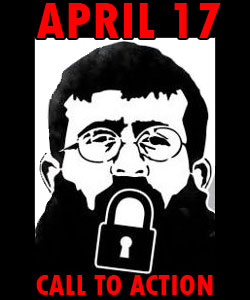
This week International Solidarity Movement is calling for international solidarity in the run up to Palestinian Prisoners Day on the 17th April.  The Palestinian prisoners struggle needs immediate international attention as Israel’s treatment of prisoners under a military judicial system starkly violates international law and fundamental human rights.  According to Addammer there are currently 4,637 Palestinian political prisoners are kept in Israeli military jails and detention centers, including 320 administrative detainees.
Some of the primary objectives of the prisoners struggle are:
  • To stop the system known as administrative detention, which allows the imprisonment of individuals without charge or trail
  • To halt the practice of solitary confinement.
  • To stop the use of torture and ill treatment. Palestinians are exposed to systematic ill and degrading treatment from the moment of arrest – both physiological and physical terrors are used as means of breaking the prisoners and getting details and information.
  • To stop the illegal transference of prisoners from the occupied territories into Israeli borders. Every time Israel brings a prisoner from the West bank jails inside their borders – they are in clear violation with the 4th Geneva Convention.
  • To stop the use of military courts for civilians.
  • To stop arrest and imprisonment of vulnerable groups such as children, elder and disabled.
Besides the suffering of individual prisoners, Israel systematically uses collective punishment towards the relatives of prisoners. The journeys to visit your husband, wife, son, or daughter may take up to 15 hours as the prisoners are systematically placed as far from their home as possible. Furthermore, visitors will face degrading processes of strip search at the borders to Israel and at the entrance to the prisons. Sometimes they even get turned away.
“All people and governments of conscience in the world have an immediate responsibility to put pressure on Israel forcing them to respect International law and human rights!” says Faris Sabbah, from Addammer, the Prisoners support and Human Rights Association.
TAKE ACTION
You can:
  • Organize a protest in front of the Israeli Embassy or consulate in our town
  • Write letters to protest the violations of rights of Palestinian political prisoners and to call for an intervention to the International Committee of the Red Cross, UN Secretary General Ban Ki-moon and your governoment or parliamentarians.
  • Write letters to Palestinian prisoners expressing your support. Read more about thise here:
Submit your photos:
What ever action you choose to take – please submit photos from your action to ISM at palreports@gmail.com.
You can get inspired from similar ISM campaign carried out in accordance to “Open Shuhada Street Campaign.”
Please follow these guidelines:
  1. In the subject line please write “ Campaign for international solidarity with Palestinian prisoners”
  2. Photos should not be a maximum of 1 MB
  3. A poster, sign, clothing or any other visual statement that expresses your solidarity with Palestinian prisoners should be visibel.
  4. Include a location of the photo (example: Hollywood sign, Hollywood, California) in the email
  5. Include the date when the photograph was taken in the email
  6. If the visual is written in a language other than English, please write the statement in the body of the email in order to be translated.
  7. Photos should be original and not edited or borrowed from another entity
  8. Photos must be submitted by April 19th.
Updated on April 17, 2012

Thursday, November 10, 2011

Motion in UK Parliament calls for release of 164 Palestinian child detainees

 
Posted on: 10 Nov 2011 | Filed under:

On 18 October 2011, an Early Day Motion was tabled in the UK House of Commons in support of UNICEF's appeal to the Israeli government to release all 164 Palestinian child detainees from Israeli military detention. The motion was signed by 25 members of the House of Commons. The full statement of the motion is presented below:
“That this House welcomes the prisoner exchange which has led to the release of the Israeli soldier Gilad Shalit and 477 Palestinian prisoners with a further 550 to be released in the next two months; notes, however, that the list of prisoners released in the first stage on 18 October 2011 does not include any children; further notes that according to figures released by the Israeli Prison Service and Defence of Children International-Palestine, at the end of September 2011 there were 164 Palestinian children (12 to 17 years) detained by Israel, including 35 between the ages of 12and 15 years; and that Israel's treatment of Palestinian child prisoners has raised serious concerns under the UN Convention on the Rights of the Child; and therefore calls on the Government and the international community to support the appeal by UNICEF for the Israeli government to release all Palestinian child detainees so that they can be reunited with their families.”


Monday, November 7, 2011

UNICEF appeals for release of Palestinian child detainees

DCI-Palestine


Posted on: 7 Nov 2011 | Filed under:

On 17 October 2011, UNICEF appealed to the Israeli Government to release all Palestinian children currently in Israeli military detention, following the announcement that they will release Palestinian prisoners as part of a prisoner swap deal.
As of 1 October, 164 Palestinians under 18 year of age were detained by Israeli authorities, most of them under charges of stone throwing. It is not clear whether the list of 1,027 Palestinian prisoners who are to be released in two stages includes children.
“UNICEF calls on the Israeli Government to release Palestinian child detainees so that they can be reunited with their families”, said Jean Gough, UNICEF Special Representative in the occupied Palestinian territory. “As stated in the Convention on the Rights of the Child, the detention of children should be used only as a measure of last resort and for the shortest appropriate period of time”, she added.
END

Sunday, November 6, 2011

MEP De Rossa calls for release of Palestinian child detainees

 
Posted on: 6 Nov 2011 | Filed under:

17/10/2011 - Irish Labour MEP Proinsias De Rossa, President of the European Parliament's Palestine Delegation (DPLC), has reiterated his call for the release of all 164 Palestinian child detainees held in Israeli jails. According to Israeli prison statistics, there are currently 164 children being held ranging in age from 12 to 17; Thirty-five of whom are younger than 15. Seventy-six of these children are serving sentences and the balance of 88 are being held in pre-trial detention. The children are mainly charged with stone throwing.

The positive potential of the prisoner swap currently underway could be greatly enhanced if these children were unconditionally released. For Israel this would not only bring her into compliance with International Law but would be a generous humanitarian gesture which would enhance her reputation globally and in the region.

Each year approximately 700 Palestinian children from the West Bank are prosecuted in Israeli military courts following arrest by the Israeli army. It is estimated that since the year 2000 over 7,500 Palestinian children have been detained and prosecuted. In addition there are credible reports of mistreat treatment during arrest and pre-trial detention.*

The detention and trial of children by military courts and their mistreatment is directly contrary to the Geneva Conventions on the treatment of children by an occupying power.

I am calling on the Member States of the EU and the EU High Representative Ms Cathy Ashton to raise this matter with the Israeli authorities in the context of the current contacts seeking to restart final status negotiations and I am copying this call to Prime Minister Netanyahu through the Israeli Ambassador to the EU in Brussels.


Proinsias De Rossa MEP
President
DPLC
European Parliament
Brussels + 32.2. 284.7681
Dublin     +353.1.874.6109
Mobile +353 87 2544 644

*LINK TO DEFENCE FOR CHILDREN INTERNATIONAL: http://www.dci-palestine.org/content/child-detention

Friday, November 4, 2011

Witnesses: Israeli forces detain teens in Hebron

HEBRON (Ma’an) -- Israeli forces detained three people in Hebron at dawn on Friday, including two teenagers, locals said.

Eyewitnesses told Ma'an that soldiers raided a house in southern Hebron and detained Amjad Salhab, 13, and Izz al-Din Salhab 14.

In Yatta village, south of Hebron, forces also detained Ala al-Shamisti, 21, from his father's house early Friday, locals said. They told Ma'an the raid damaged furniture in the family home.

An Israeli army spokesman said forces conducted the raid with Israeli police, and confiscated weapons before detaining one man. There were no other detentions in Hebron overnight, he said.

Friday, October 14, 2011

Military Order 1676 – Raising the age of majority

DCI-Palestine


[11 October 2011] – On 27 September 2011, General Avi Mizrahi, the Israeli military commander in the occupied West Bank, issued Military Order 1676 raising the age of majority in the military courts from 16 to 18 years. The new military order also makes provision for the notification of a child’s parents that the child has been arrested and informing the child that he/she has the right to consult with a lawyer, but without stating precisely when this consultation should occur. Contrary to international law, the new order has only been circulated in the Hebrew language.
DCI-Palestine welcomes the raising of the age of majority to 18, which after 44 years, brings Israeli military law in conformity with international standards on this issue. However, DCI remains concerned that Palestinian children as young as 12 years continue to be denied many basic rights when detained under military law, and prosecuted in military courts. These concerns include the following:
  1. The majority of children continue to be arrested from their homes in the middle of the night by heavily armed soldiers, causing extreme fear and anxiety:
  2. The overwhelming majority of children continue to be painfully tied with a single plastic cord in violation of Israeli army procedures introduced in April 2010;
  3. Numerous and credible reports of the ill-treatment of children during arrest, transfer and interrogation continue to be received. In some cases this treatment may amount to torture. No effective action appears to have been taken to remedy this situation;
  4. Children are still not informed of their right to remain silent;
  5. Children continue to be interrogated in the absence of a parent, a right afforded to most Israeli children;
  6. Children continue to be interrogated in the absence of a lawyer, and generally only receive legal advice after their interrogation is completed and they have provided a confession;
  7. Effective measures to prevent ill-treatment during interrogation, such as the audio-visual recording of all interrogations, have still not been introduced, even though this safeguard was recommended by the UN Committee Against Torture in mid 2009;
  8. Children continue to be denied bail in around 90 percent of cases in violation of article 37(b) of the UN Convention on the Rights of the Child; and
  9. The overwhelming majority of children continue to receive custodial sentences that are frequently served in prisons inside Israel, in violation of article 76 of the Fourth Geneva Convention which prohibits such transfers.
In order to meet its legally binding international obligations towards children, DCI continues to demand that Israeli military authorities implement binding orders that immediately and effectively address the above concerns.


5 Oct. '11: Army raises minority age of Palestinians to 18, as in Israel; violation of minors' rights continues

Israeli Border Police officers detain a Palestinian near Nablus. Abed Omar Qusini, Reuters, 2010. B'Tselem

Army raises age of minority in military-justice system in West Bank to 18, same as in Israel, but fails to make other necessary changes to protect minors
On 27 September 2011, OC Central Command signed Amendment 10 to the Order Regarding Security Provisions. The amendment changes provisions relating to minors in the military-justice system, which applies to Palestinians in the West Bank. Israelis living in the West Bank are prosecuted according to Israeli penal law.
The amendment raises the age of minority from 16 to 18. B'Tselem welcomes this amendment, which aptly conforms the age of minority in the West Bank to the customary age around the world, including in Israel. However, it does not deal with the grave infringement of Palestinian minors’ rights, as Israeli authorities have not, thus far, respected the rights of Palestinians under the age of 16. B'Tselem’s report No Minor Matter revealed how the authorities breach the rights of Palestinian minors suspected of stone- throwing at all stages of the process: arrest, interrogation, trial, and imprisonment.
  • Involvement of parents: The obligation to notify parents, without delay, that their child has been arrested existed in the pre-amendment legislation. The amendment slightly expanded the requirement to include the giving of immediate notice to parents with respect to both arrest and interrogation of their child. However, the amendment contains several qualifications that enable those responsible to refrain from such notification. First, if the minor does not provide details on his parents, the authorities are not obligated obtain the details. Second, the amendment requires the authorities only to make a “reasonable effort under the circumstances” to locate the parents, but fails to define the expression “reasonable effort.” A third exception arises where there is a “reasonable suspicion” that notice will obstruct the interrogation or “harm the security of the region.” The order does not interpret these expressions, thus giving the interrogators great discretion.
  • Caution and right to consult: The amendment requires the authorities to inform minors who have been arrested of their right to consult with an attorney in private. However, the amendment does not properly guarantee realization of the right: it only requires the interrogator to inform the minor’s attorney about the interrogation, and specifies that the giving of notice will not delay the interrogation. In addition, the interrogator must give notice to “a defense attorney whose particulars were provided by the minor,” although it is unlikely that a minor under arrest will be in possession of an attorney's contact details.
  • Statute of limitations: Under the pre-existing legislation, a minor could not be prosecuted for an offense if two or more years had passed since commission of the offense. The amendment reduces the period to one year, except as regards a long list of offenses that are defined security offenses, such as causing death, assault, stone-throwing, organizing and participating in demonstrations, disturbing a soldier in the performance of his duties, and throwing a burning object. In effect, the amendment will not apply to most minors accused of committing what are classified as security offenses.
  • Holding minors with adults in detention and in prison: Holding minors with adults in detention and in prison: The amendment contains an exception to the sweeping prohibition on holding minors with adults, and states that minors over age 16 may be kept with adults, provided that doing so benefi44LRL9w4DDRJ5pRmSOJ; preferredOpdo not have access to minors during sleeping hours. There is no explanation why minors above age 16 are allowed to be held with adults, the age of minority now having been raised to 18. Holding minors and adults together is problematic. As a judge of the Youth Military Court in Judea, Major Sharon Rivlin-Ahai, said regarding incarceration of 16 and 17 year olds with adults: “It is unnecessary to go into detail on the damage such incarceration can cause a minor later in life” (Mil. Ct. (Judea) 1261/09, Military Prosecutor v. H.P., 23 February 2009).
These slight changes do not provide for proper protection the rights of Palestinian minors suspected of having committed offenses. There still is a substantial gap between the rights granted minors under Israeli and international law and those granted under the military legislation. B'Tselem calls for immediate changes in the military legislation to provide Palestinian minors with the protections to which they are entitled, including the right to have a parent present at the interrogation, prohibition of interrogation at night, strict prohibition on imprisoning minors under 14, advancement of to alternatives to detention and imprisonment, and all other protections provided in Israel’s Youth Law.

DCI - Palestine Detention Bulletin - Issue 21 - September 2011

DCI-Palestine's monthly bulletin on detention issues.

In this issue: 9% decrease in the number of children imprisoned since last month; Complaint submitted to Israeli authorities regarding ill-treatment; Report submitted to UN Special Rapporteur on Torture on situation facing Palestinian children in East Jerusalem; New East Jerusalem report; New Military Order 1676 raises age of majority in military courts from 16 to 18.
Detention Bulletin - Issue 21- September 2011

Wednesday, October 12, 2011

Families relieved by prisoner swap

Family members of Palestinian
prisoners still do not know who will
be released (IRIN/Erica Silverman)
Ma'an

GAZA CITY (IRIN) -- Palestinian families are eagerly awaiting the publication of the names of the more than 1,000 detainees that are to be released in a ground-breaking prisoner swap deal with Israel.

The Israeli cabinet approved the agreement today, under which captive Israeli soldier Gilad Shalit will be freed in exchange for 1,029 Palestinian prisoners held in Israeli jails.

Shalit has been in Hamas captivity since June 2006, captured in a cross-border raid executed by Hamas-linked militants. In response, Israel targeted Gaza’s main power station that supplies electricity to Gaza residents.

Outside the International Committee of the Red Cross office in Gaza City, Um Mahmoud holds a large photograph of her son Mahmoud Rais, now aged 30. He was arrested in 2003.

“He was detained at an Israeli checkpoint inside Gaza and we never learned why he was sentenced,” she says. “This release is a victory for Palestinians and for the government.”

Um Mohamed also clutches a photograph of her husband Salama Musleh, arrested and detained by Israeli authorities in 2003 for killing an Israeli settler. She claims the settler killed seven Palestinians.

“God wiling I will find my husband’s name on the list, I have been waiting 18 years,” she says, adding: “The Palestinian Authority failed to release Palestinian prisoners without a peace process.”

It is not yet clear whether any children will be included in the release. At the end of June 2011, 209 Palestinian boys aged 12-17 were in Israeli detention, according to UNICEF.

During the reporting period (May and June 2011), 15 cases were documented of ill-treatment - in some cases amounting to torture of Palestinian boys aged 13-17 by the Israeli authorities during arrest, interrogation and detention.

Affidavits were taken for all cases that involved the use of hand-ties (14 instances), blindfolding (11), beatings (10), stripped of clothes (10), exposure to heat/cold/rain (5), kicking (5), and verbal abuse (5).

Hunger strike

Ex-prisoners and families of detainees have been staging a hunger strike outside ICRC headquarters in Gaza City for over a week, in solidarity with the estimated 1,000 Palestinian prisoners inside Israeli jails who began a massive hunger strike on 27 September protesting inhumane conditions inside the jails.

Strikers’ demands include ending the use of isolation cells and the denial of basic health treatment.

“The ICRC has facilitated medical visits to the strikers from the start,” said ICRC spokesperson Phiri. “We have shifted resources to focus on these prisoners,” he said.

According to the agreement, brokered by Egyptian intelligence, Shalit is expected to be released in about a week, along with the release of 479 Palestinian security prisoners.

Of these 479 prisoners, 96 are from the West Bank and 131 from the Gaza Strip; they will be allowed to return to their homes. Fourteen prisoners from East Jerusalem and six Israeli Arabs will also be allowed to return to their homes.

About half of the released prisoners (203) will not be allowed to return to their homes. Forty will be deported and the rest transferred to Gaza.

Twenty-seven women, all the women imprisoned in Israel for security offenses, will be released. Two will be deported, one to Gaza and one to Jordan.

In two months, Israel will release another 550 prisoners of its choosing.

Over 5,200 Palestinians were being held in Israeli custody for occupation-related offenses in August, including 29 women, according to the UN Office for the Coordination of Humanitarian Affairs.

Of that number 272 are administrative detainees, Palestinians held by the Israeli authorities without charge or trial, allegedly for preventive purposes.

“Sigh of relief”

Israeli Prime Minister Benjamin Netanyahu said the deal succeeded in bringing Shalit home, while maintaining the security of Israeli citizens.

Some in Israel, however, questioned the move, concerned that releasing so many Palestinian prisoners for one Israeli soldier could encourage future abductions.

“For the last five years, the Shalit case has shaped the feelings of many Israelis towards Gaza, as well as the policies of successive Israeli governments towards Gaza,” said Sari Bashi, director of Israeli NGO Gisha, the legal center for freedom of movement.

“The sigh of relief is palpable throughout Israel and of course the relief felt by the Shalit family and the families of the prisoners who will be released,” she said.

Israeli men and women must serve in the military. In a country where most families watch their young son or daughter leave for the army, the Shalit case has been an emotional issue.

Sunday, October 9, 2011

Voices from the Occupation: Ahmad F. - Detention

DCI Palestine

Name: Ahmad F.
Date of arrest: 6 July 2011
Age: 15
Location: Burin village, occupied West Bank
Accusation: Throwing stones
On 6 July 2011, a 15-year-old boy from Burin village, near Nablus, in the occupied West Bank, is arrested by Israeli soldiers from the family home at 2:00 am.
At around 2:00 am, on 6 July, 15-year-old Ahmad was up late socialising with family members who had just arrived from Jordan. “We were all sitting on the balcony […] when we heard people climbing up the stairs,” recalls Ahmad. “Suddenly, many soldiers stormed the house. We were surprised to see them. They started shouting at us and ordering us into the living room.” Some soldiers started searching the house causing a big mess. Ahmad’s two-year-old nephew started crying, and this “annoyed the soldiers who started shouting and asking his mother to shut him up.”
Approximately one hour after the soldiers arrived, Ahmad was informed that he was ‘wanted for interrogation’. “One of the soldiers immediately tied my hands from the front with three sets of plastic cords. One cord for each hand and one cord connecting the two. The ties were very tight and caused me much pain. Then another soldier grabbed me by the arm and took me out of the house.” Ahmad’s brother asked the soldiers where he was being taken and was attacked by a soldier. “He started hitting him hard with the barrel of his rifle in front of the family, including the children, who became horrified and started crying,” recalls Ahmad. On exiting the house Ahmad was also blindfolded.
Ahmad reports being led about 50 metres to some waiting vehicles, which then transported him to Huwwara interrogation and detention centre, on the outskirts of Nablus. On arrival at the centre Ahmad was pulled out of the vehicle and made to stand beside it. ‘They were chanting, laughing and shouting in my ears,” recalls Ahmad. “They were making fun of me. One of them placed his mobile phone beside my ear and played a police siren so loud. Then one of them grabbed me by the arm and placed my head against the car engine, as another one kept stepping on the accelerator. They did this several times. My whole body started shaking.” Ahmad reports that he was then taken inside the gates of the centre but left outside from about 5:00 am until 3:00 pm the following day. He was not brought any food. Whilst waiting outside, Ahmad reports being verbally abused and told: ‘We want you to die out here.’ Whenever Ahmad tried to sleep a soldier would start shouting and kicking him to keep him awake.
At one point, whilst Ahmad was waiting outside, some soldiers brought a dog and Ahmad was pushed to the ground. “I managed to see the dog from under my blindfold,” he says. “They brought the dog’s food and put it on my head. I think it was a piece of bread, and the dog had to eat it off my head. His saliva started drooling all over  my head and that freaked me out. I was so scared my body started shaking because I thought he was going to bite me. They saw me shaking and started laughing and making fun of me.  Then they put another piece of bread on my trousers near my genitals, so I tried to move away but he started barking. I was terrified.”
Later that day Ahmad was taken to the police station in Ari’el settlement and interrogated. “The interrogator removed my blindfold but kept me tied,” recalls Ahmad. “The interrogator accused me of throwing stones, but I denied it.” The following day, Ahmad was placed inside another vehicle and transferred to Megiddo prison, inside Israel. “The air conditioner was turned on and it was freezing inside. I asked them to turn it off, but they refused even though my body started shivering.” The vehicle made a number of stops before arriving at Megiddo at around 11:00 pm. Ahmad was not provided with any food during the eight hour journey, and was strip searched on arrival at the prison.
Forcibly transferring Palestinian children out of the occupied West Bank violates Article 76 of the Fourth Geneva Convention. For further information on Palestinian children in detention see – In their own Words: A report on the situation facing Palestinian children detained in the Israeli military court system (July 2011).

DCI submits complaint on behalf of child detainee

 DCI Palestine

[19 September 2011] – On 7 September 2011, DCI submitted a complaint to the Israeli authorities on behalf 17-year-old Ahmad R. The complaint requests that the Judge Advocate General opens an investigation into allegations that Ahmad was mistreated by Israeli soldiers in May 2011.
At around 1:30 am, on 20 May 2011, Ahmad was asleep at the family home in Azzun, in the occupied West Bank, when he was woken by a sound bomb. Ahmad was ordered out of the house with the rest of his family and made to strip naked in front of everybody. After being permitted to re-dress, Ahmad was tied and blindfolded, before being placed in a military vehicle and transferred to the nearby settlement of Zufin. Ahmad reports that he was beaten by soldiers whilst inside the vehicle. On arrival at the settlement, Ahmad was dragged out of the vehicle and fell down on his face, causing both his mouth and nose to bleed.
Four days after being arrested, Ahmad was transferred to Petah Tikva interrogation centre, near Ben Gurion airport inside Israel, in violation of Article 76 of the Fourth Geneva Convention which expressly prohibits such transfers.
Ahmad’s story is available on-line.

Thursday, October 6, 2011

Israeli Judge Challenges Illegal Interrogation Of 13-year-old Boy

Thursday October 06, 2011 19:24 by Saed Bannoura - IMEMC News

A gag order was lifted Wednesday in the case of a 13-year-old Palestinian boy who was recently acquitted of charges of throwing stones at an Israeli bus, after an Israeli judge questioned the interrogation tactics used by police while holding the child in custody.
Israeli soldiers abduct a child (archive image from AVoiceFromPalestine blog)

The boy was abducted in 2009 and accused of throwing stones at an Israeli bus, a charge which he denied. According to transcripts of the intense interrogation of the boy, the interpreter who spoke to him in Arabic gave widely differing interpretations of the interrogator's questions and statements, sometimes even contradicting the Hebrew.

The boy was never told that he had the right to remain silent. Instead, the interpreter told him, "Everything that [the interrogator] asks you, answer her."

When the boy continued to maintain his innocence, the interpreter repeatedly called him a liar, then said, "You're going to stay in jail and we'll teach you ... Don't make me hit you."

Although the child himself was acquitted (two years after his arrest), no charges or reprimands have been brought against the interrogators or interpreter.

A recent report by Defence for Children International found that none of the ten recommendations made by the group two years ago about detention of children have been carried out by Israeli authorities. These recommendations include ending the interrogation of minors without a parent or lawyer present, ending the detention of children in the same facilities as adults, and investigating dozens of allegations of torture of children by Israeli police and military.

There are currently 251 Palestinian children detained by Israel, all of whom are being held in adult prisons and prison camps.

Sunday, September 11, 2011

Israeli special force abducts five men south of Gaza

[ 11/09/2011 - 12:06 PM ]


GAZA, (PIC)-- An Israeli military force abducted Saturday night five young Palestinian men east of the Israeli kibbutz  Kissufim, adjacent to the southern Gaza Strip, security sources and witnesses said in identical reports.
Israeli jeeps accompanied by reconnaissance aircraft and Apache helicopters briefly entered east of Qarara in the Gaza Strip and swiftly abducted the men, covering themselves by firing heavy ammunition at Palestinians and their property, the sources said.
Later on Sunday morning, three of the abductees were set free by the Israeli security forces after being severely assaulted, security sources said.
The whereabouts of the other two abductees as well as the motives behind the operation remain a mystery.

---------------------
Israeli forces briefly detain 3 boys in central Gaza

GAZA CITY (Ma'an) -- Israeli forces on Sunday released three Palestinian boys who were detained overnight near a military base in the central Gaza Strip, a Ma'an correspondent reported.

The boys, aged between 11 and 15, were detained near Kissufim army base south of Deir al-Balah.

Witnesses said at least eight army jeeps entered Gaza near Al-Qarara village and opened fire from military towers before detaining the boys.

The detainees were interrogated for several hours and then released, a Ma'an reporter said.

An Israeli military spokeswoman said soldiers apprehended three Palestinians who were trying to cross the security fence into Israel.

Thursday, September 8, 2011

Israeli court sentences two Jerusalemite minors to jail

[ 08/09/2011 - 08:43 AM ]


OCCUPIED JERUSALEM, (PIC)-- The Israeli central court in occupied Jerusalem sentenced two Palestinian Jerusalemite minors to 15 months behind bars for throwing stones at Israeli vehicles.
The court verdict passed on Thursday said that the two minors from Silwan, occupied Jerusalem, threw stones at an Israeli vehicle and injured its passengers.
The Israel radio said that the court ruling also ordered the minors to pay 30000 shekels to the injured persons.

Wednesday, August 10, 2011

DCI Detention Bulletin - Issue 19 - July 2011

DCI-Palestine's monthly bulletin on detention issues.
In this issue: New report on Israel’s compliance with ICCPR; Urgent Appeal – Children of Azzun; New report on the situation facing Palestinian children detained in the Israeli military court system; Three new case studies on child detainees.
Detention Bulletin - Issue 19 - July 2011

Voices from the Occupation: Sameer S. - Detention


Name: Sameer S.
Date of arrest: 29 June 2011
Date of affidavit: 6 July 2011
Age: 12
Location: Azzun, occupied West Bank
Accusation: Throwing stones
On 29 June 2011, a 12-year-old boy from Azzun, in the occupied West Bank, is arrested by Israeli soldiers from the family home at 2:00 am.
‘At around 2:00 am I was sleeping when I woke up to banging on the outside door,’ says Sameer. ‘Someone was banging hard on the door and I didn’t know why. I got up and went to the living room and saw my parents and siblings. We were very scared.’ Sameer’s father went and opened the door. ‘About five minutes later I heard my father saying: “Bring the boys downstairs and keep the girls upstairs.” I felt so scared I started shivering. Me and my brother went downstairs with my mother and saw around six soldiers with my father. I was very scared of the soldiers whose faces were covered in black showing only their eyes. One of them did not cover his face and he was holding a digital camera.’ The soldiers spoke to Sameer’s father in Hebrew and he translated. The boys were ordered to raise their hands and the soldier with the camera took their photo.
‘The soldier talking to my father took a piece of paper out of his pocket and started checking it and my father’s ID. “Where’s Sameer?” he asked. I became terrified but I didn’t think they would take me. He talked to my father in Hebrew and then pointed at me and said: “Bau, bau,” which I think means come here in Hebrew. At that moment I realized they wanted me. I was so shocked and horrified I couldn’t breathe a single word. My father comforted me and asked me not to be scared. Meanwhile, two soldiers grabbed me by the arms and took me out of the house. They all left the house and closed the door behind. I saw more than 15 soldiers around the house in the yard and near the front door. Two soldiers blindfolded me and they also tied my hands behind my back with one set of plastic cords. The soldiers were talking to each other in Hebrew.’
Sameer was then led to a vehicle and made to sit on the floor. About 15 minutes later the vehicle arrived at an unknown location. Sameer was pulled out of the vehicle and made to sit on the ground. ‘Meanwhile, I heard dogs approaching us,’ recalls Sameer. ‘I became terrified to hear dogs approaching. Soldiers were saying things in Hebrew and I didn’t understand. I felt they were getting closer and I shouted: “The dogs, the dogs,” trying to move away, but I couldn’t because my hands were still tied behind my back. “Keep them away,” I heard others shouting. “Keep the dogs away, we haven’t done anything to you,” I cried. I was petrified because the dogs could jump at me at any moment. This continued for about 20 minutes, during which time I kept crying and shouting. Others were shouting as well. Male and female soldiers were laughing and saying things in Hebrew,’ says Sameer.
After 20 minutes, Sameer was taken into a clinic and briefly asked some questions about his health. After the questions, Sameer was re-blindfolded and his plastic ties were replaced with metal cuffs tied to the front. Sameer was then placed on the ground for about one-and-a-half hours. ‘I felt very cold,’ says Sameer. After sitting on the ground for more than an hour, Sameer was placed in another vehicle and transferred to Ari’el settlement for interrogation.
‘I was taken to a room measuring 3x3 metres,’ recalls Sameer. ‘They removed the blindfold once I entered the room. There was a man in civilian clothes sitting behind one of the desks. He was short, bald and plump. He ordered me to sit in a wooden chair in front of him. There were another two men in civilian clothes in the room. “You threw stones at the bypass road near the gate,” the short man said once I sat down. “No I didn’t,” I said. “Where were you on Nakba day?” He asked.  “I was home because my father didn’t allow me to leave the house,” I said. He spoke fluent Arabic. “I’ll beat you up if you don’t tell the truth and confess to throwing stones,” the interrogator said. “I didn’t throw any stones and I didn’t do anything to you,” I said while shaking with fear. He got up and approached me to slap me on the face and neck. “You’ll confess to everything,” he shouted. He kicked me while I was sitting in the chair with my hands handcuffed to the front. “If you don’t confess, I’ll beat you more and throw you out of the window,” he said. He then grabbed me by the shirt and said he would throw me out of the window. There was a big window in the room. I was terrified but I didn’t confess. “I didn’t do anything to you and I didn’t throw stones,” I told him. He started talking to the other men in Hebrew. They never talked to me. They just kept coming in and out,’ recalls Sameer.
Sameer then recalls signing papers written in Arabic and Hebrew without reading them. He was then taken out and made to sit in a corridor. It was about 2:00 or 3:00 pm. Sameer was untied and his blindfold was removed and he was given a meal. About an hour later a car arrived and he was driven to Qalqiliya. He was handed over to the Palestinian police and released.
‘I’m still afraid of soldiers and I can’t sleep at night. I’m anxious and still traumatized because of what happened. This was the first time I went through such a horrible experience which terrified me. I’m scared of the darkness. I keep thinking soldiers will come back and arrest me,’ says Sameer.
Since January 2009, DCI-Palestine alone has documented 40 cases of children from Azzun village who have been detained by Israeli forces, mostly on suspicion of throwing stones. These cases only represent a small sample of the total number of cases involving the arrest of children from Azzun. See Urgent Appeal 4/11 - Children of Azzun.

Israel’s compliance with UN Convention – 12 months on


 [DCI - 1 August 2011] – On 29 July 2010, the UN Human Rights Committee (the Committee) issued Concluding Observations after reviewing the State of Israel’s compliance with the Convention on Civil and Political Rights (CCPR). In the Concluding Observations, the Committee raised a number of concerns relating to the prosecution of Palestinian children in Israeli military courts and made the following recommendations and expressions of concern:
  • Refrain from holding criminal proceedings against children in military courts;
  • Ensure that children are only detained as a measure of last resort and for the shortest possible time period;
  • Ensure that parents or close relatives are informed where a child is being detained and provide the child with prompt access to free and independent legal assistance of its own choosing;
  • Expressed concern that children can be detained for up to eight days before being brought before a military judge;
  • Expressed concern that children are interrogated in the absence of parents or close relatives and a lawyer, and they are not audio-visually recorded. The Committee recommends a guaranteed right that all proceedings involving children are audio-visually recorded;
  • Expressed concern that children of the age of 16 are tried as adults in the military courts, and recommends that children not be tried as adults;
  • Expressed concern that children are not informed promptly, in a language they understand, of the charges against them;
  • The Committee is ‘very concerned’ at allegations of torture, cruel, inhuman or degrading treatment of children and recommends that reports of torture and ill-treatment of detained children are investigated promptly by an independent body; and
  • Recommends that all trials are conducted in a prompt and impartial manner, in accordance with fair trial standards.
The Committee also requested that Israel provide an update in 12 months on the implementation of the recommendations relating to children. Pursuant to this follow up procedure, DCI-Palestine today submitted a report to the Committee containing updated information relevant to the implementation of its recommendations.
The report finds that Palestinian children continue to be systematically ill-treated in the Israeli military court system and none of the Committee’s recommendations have been satisfactorily implemented in the past 12 months.


Monday, June 6, 2011

PA: Israel detained prisoner's daughter during visit

BETHLEHEM (Ma'an) -- Guards at an Israeli prison detained a 13-year-old girl visiting her father, the Palestinian Authority Ministry of Prisoners Affairs said Monday.

Prison guards detained Samah Majdi Musallam while she was visiting her father, who is serving a 13-year sentence in an Israeli prison in the Negev desert, the ministry said in a statement.

The ministry said the girl was separated from her father by an iron mesh fence when guards rushed to detain her. She was accused of trying to smuggle something to her father, the statement said.

She was interrogated by Israeli police and tried at a court in Beersheva in southern Israel, the ministry added.

PA Minister of Prisoners' Affairs Issa Qaraqe said the case was not unprecedented.

"Several times prisoners' relatives have been detained during visits under trivial pretexts. In fact family visits have become a means of punishment and humiliation," Qaraqe said.

Gaza ministry: 370 Palestinians detained in May

GAZA CITY (Ma’an) -- The Ministry of Prisoners Affairs in Gaza released a report Sunday, tallying a total of 370 detentions carried out by Israeli forces targeting Palestinians during the month of May.

According to the report, among those detained were 40 under the age of 15, five women, two lawmakers, and 20 international peace activists.

The detentions were carried out during 540 invasions and raids on Palestinians ares, the report said. In 2009, the UN cataloged an average of 103 arrest and raid operations per week in the West Bank.

Friday, June 3, 2011

Group: 26 from Bethlehem arrested in May


RAMALLAH (Ma’an) -- Israel arrested 26 residents of Bethlehem last month, the Palestinian Prisoners Society said Wednesday.

Abed Khalil, the head of the rights group, said arrests increased in May among minors.

The army destroyed property and used jeeps during the raids that arrested many schoolchildren, he said.