Showing posts with label right of education. Show all posts

Thursday, April 19, 2012

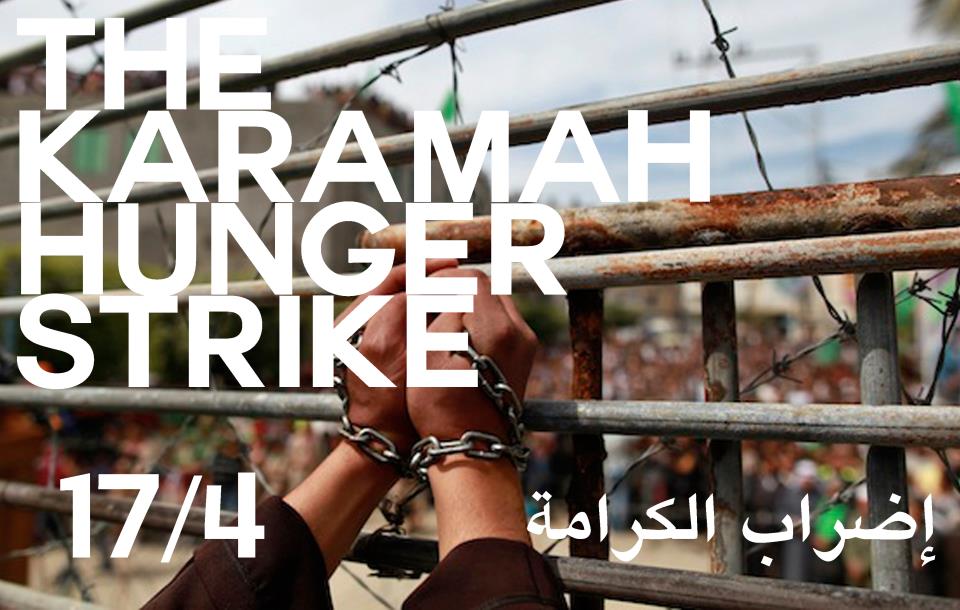
Hunger striking prisoners facing sharp repression and continue their demands

Samidoun

Palestinian prisoners on hunger strike are facing sharp repression from the Israeli Prison Administration. As reported by Addameer and others, Palestinian prisoners on hunger strike have reported confiscation of personal items and warm clothes. In response to these attacks, prisoners in Nafha are threatening to begin to refuse water as well.
One group of Palestinian prisoners associated with the Popular Front for the Liberation of Palestine at Eshel prison participating in the strike have been transfered to Ohalei Kedar prison in retribution, while Hamas prisoners at Eshel prison on hunger strike were separated from one another and moved into the rooms of Fateh prisoners, in an attempt to exacerbate factional tensions.
At Ramon prison, Palestinian hunger strikers have been moved into isolation cells and hunger strikers throughout Israeli prisons are being denied access to independent doctors. Addameer lawyer Samer Sama’an has been banned from visiting all prisoners from 6 months, the second time in recent months that such a ban has been applied to an Addameer lawyer during prison hunger strikes.
In response to these attacks, Palestinian prisoners on hunger strike issued another statement reiterating their demands:
Despite the threat of the executioner, and the strength of his weapons, we will
1 – end the policy of solitary confinement
2 – close the file of administrative detention
3 – Cancel the actions taken after the capture of Shalit and the most important of which prevent the prisoners of Gaza Strip’s (456) prisoners from visiting their parents
4 – Allow higher education.
On Prisoner’s Day, this will not be just another day of another year. Therefore, they are preparing to confront the torturers, the executioners, and their weapons, and despite the failure of the international community, we stand armed with only our empty stomachs and solid will derived from the heroic march of our people who continue to resist, and we have faith in victory and the justice of our struggle for freedom.

Wednesday, October 5, 2011

IPA Starts New Measures To Punish Detainees

Freed All Detainees - image paldf.net

Wednesday October 05, 2011 10:39 by Saed Bannoura - IMEMC & Agencies

Israeli Maariv reported on Wednesday morning that the Israeli Prison Administration (IPA) has started a series of measures to increase pressure on the Palestinian detainees in an attempt to break their open-ended hunger strike.
The new measures include depriving the detainees of education, reducing the number of TV channels permitted, and withholding certain types of food formerly allowed.

The IPA decided that the detainees can watch only ten satellite TV channels: four Israeli channels (1, 2, 10, and 33), two Russian channels, and four Arabic channels. The Qatar-based news agency, Al Jazeera, was taken off the list.

Earlier this week Israeli soldiers attacked several prisons, searched detainees’ rooms, caused injuries to a number of detainees, and fired gas bombs in Nafha and Asqalan prisons. Soldiers also moved detainees from Shatta to Majiddo prison. Several detainees were put in solitary confinement.

Palestinian political prisoners in all Israeli prisons are demanding better living conditions, adequate medical care, and an end to solitary confinement policies and other violations of international law and the Fourth Geneva Convention.

Wednesday, September 7, 2011

Prisoners’ Affairs Ministry: Israel arrested 420 Palestinians in Ramadan

[ 07/09/2011 - 08:00 PM ]

GAZA, (PIC)-- The Ministry of Prisoners’ Affairs has said that the Israeli occupation authorities placed 420 Palestinians in detention during the Islamic holy month of Ramadan in a fresh report released on Wednesday.

It was that month that Israel carried out one of the most massive arrest sweeps in Al-Khalil in years, rounding up some 190 Palestinians there in just a few days.

Among those arrested that month were 45 minors, four women, three of whom are wives of Palestinians already detained in the Israeli prisons, and three members of the Palestinian legislature.

The new report also documented the repressive circumstances that continued inside the Israeli prisons throughout the Muslim holy month. It said that special units continued to carry out search raids in the Megiddo prison during the morning meal ahead of the Ramadan fast, and that some 40 prisoners suffered from food poisoning from spoiled food served to them in the canteen.

Other repressive acts were also reported. Prisoners in the Negev prison were once again required to wear uniforms whenever leaving prison in spite of prior agreements. All books were also removed from a sector in Damon prison, where a ban was also placed on books brought in by family members during visits.

Also that month, the prisoners were banned from bringing foods into the prison and were also prohibited from receiving extra funds during Ramadan to purchase extra materials needed for the month as well as for the Eid al-Fitr holiday, marking the end of the Ramadan.

The report says that Israeli occupation authorities froze all funds for the education of prisoners enrolled in the open Hebrew university until further notice, under an official decision to stop the education of Palestinian prisoners inside the prisons.

Also on the political level, the Israeli legislative body, the Knesset, approved amending a law allowing the prison administrations to ban security prisoners from receiving lawyer visits without referring to the courts or providing justification.

More than 50 prisoners were transferred to administrative detention, including Palestinian MP Mohammed Mutlaq Abu Juheisha and Ayed Doudein, who has spent more time in administrative detention than any other prisoner.

Other prisoners, such as MP Marwan al-Barghouthi, were place in solitary confinement. Another prisoner was isolated for smuggling a letter over to his 85-year-old mother, the report highlights.

Monday, August 8, 2011

PA: Israel should reimburse tuition for prisoners

RAMALLAH (Ma’an) -- The Palestinian Authority ministry of prisoners affairs wants Israel to return tuition money paid by the PA to detained students who are no longer permitted to enroll in courses.

The prison service has frozen all the money allocated for tuition on behalf of detainees enrolled in the Open University, after the government decided to deprive Palestinian prisoners of education.

Of the 6,000 detainees in Israel, 280 are enrolled in Open University. Some would be graduating soon.

Prisoners minister Issa Qaraqe said Saturday that his ministry would appeal to Israel's High Court of Justice seeking to restore the money allocated for prisoners’ tuition.

In a separate matter, Hussein Ash-Sheikh, a Palestinian lawyer who works for the ministry, said Saturday that Israeli soldiers tried to rape a 13-year-old Palestinian at Etzion detention center.

The lawyer based his claim on what he heard from the teen’s brother, whom he identified as 26-year-old Ammar Sa’di Jabir from Hebron in the southern West Bank.

He said Ammar was detained along with his brother Mahmoud, 13, from their home on July 25. He was taken to Kiryat Arba detention center where the soldiers beat him on the face and body before transferring him to Etzion.

Ash-Sheikh said he noticed during a visit that “Ammar’s body had bruises and swelling, and he lost some teeth.”

He added that Mahmoud was also beaten and soldiers took him to a deserted room and tried to rape him. When he saw the soldiers, Ammar added, he hurried to defend his brother and clashed with them.

Ammar was then accused of attacking soldiers, Ash-Sheikh said.

In another incident, Ash-Sheikh said Yousif Abdul-Aziz, 27, a prisoner from Jenin, filed a complaint against an Israeli warden accusing the official of taking inappropriate photos of him.

The photos were taken at Megeddo prison while he was being strip-searched, Ash-Sheikh said.

Officials at Israel's prison service could not immediately be reached for comment.

Monday, April 4, 2011

Hamas prisoners announce protests against IPS

[ 04/04/2011 - 10:20 AM ]


WEST BANK, (PIC)-- Hamas prisoners in Israeli jails have announced a state of high alert as steps have been launched to protest against the Israeli prison system.
”The battle” may start at any hour or it may be delayed to make further arrangements, Hamas's high committee for prisoner struggle said on Sunday.
They said the first step will be a hunger strike participated in initially by a limited number, so prisoner leadership does not feel that the strike weakens the front as time progresses.
The prisoners speaking on behalf of the Hamas committee said they have devised a plan and called on all prisoners to commit to it. They have also given several directives, asking prisoners to keep their hair short and to change their diet habits to prepare for the upcoming ”battle”.
Liason during this period must only be made by the committee which will announce the protest steps and inform the prison administration, the committee said. The committee will decided when the action will be taken and when it will be suspended.
The escalation comes after the Israeli Knesset passed a package of laws last week tightening restrictions on Palestinian prisoners.
Separately, a report released Monday by a Palestinian human rights group says the Israeli Prison Service placed one man in isolation and severely beat him after finding a pen cap in his pocket.
After the pen cap was found in his possession last month several restrictions were placed against him. He was placed in isolation for a week, banned from visits for two weeks, denied the right to education for an entire year and banned from using the canteen for two weeks.
Cameras were placed in his cell, and his cell was invaded by six prison guards who tied him  to his mattress, stripped him naked and began beating him. He said a guards tried to rape him amid accusations that he tried to commit suicide.

Monday, March 14, 2011

EU Parliament to review prison conditions inside Israel

 March 09, 2011

DCI-Palestine


[9 March 2011] - On 15 March 2011, the EU Parliament's Sub-Committee on Human Rights will review prison conditions in Israel and the Occupied Palestinian Territory. In advance of the hearing, DCI-Palestine has lodged a submission relating to conditions faced by Palestinian child detainees held in Israeli interrogation and detention facilities and prisons.
DCI-Palestine's submission to the Sub-Committee provides evidence of ill-treatment and torture during the initial stages of detention, and also includes:

  • Information that 27 percent of Palestinian child detainees are forced to sign confessions written in Hebrew.
  • Information that 58 percent of Palestinian child detainees are being held inside Israel, in contravention of Article 76 of the Fourth Geneva Convention;
  • Information indicating that as many as 43 percent of child detainees are not adequately separated from adult prisoners;
  • Evidence that 55 percent of Palestinian child detainees complain of inadequate food, water or shelter;
  • Information suggesting that most Palestinian child detainees do not receive family visits during the first three months of their detention, and no Palestinian child detainees are permitted to maintain telephone communication with their families;
  • Evidence that Palestinian child detainees receive inadequate education services inside prison, and in some cases, no education at all; and
  • Evidence that children held in the Al Jalame Interrogation and Detention Centre near Haifa, are routinely subjected to serious mistreatment, including position abuse, sleep depravation and solitary confinement.
DCI-Palestine continues to demand that all interrogations of Palestinian child detainees be audio-visually recorded, and no Palestinian child is detained inside Israel, in contravention of Article 76 of the Fourth Geneva Convention.

Monday, February 7, 2011

Palestinians held in Etzion prison to announce hunger strike if demands not met

[ 07/02/2011 - 01:01 PM ]


RAMALLAH, (PIC)-- Palestinians held in the Israeli Etzion prison are in the process of announcing a hunger strike in protest of inhumane treatment at the facility, the Palestinian Prisoner Society said.
The prison administration has yet to offer a reason for its stubborn refusal to allow blankets and clothes, the PPS's attorney said. The captives also complain of the poor quality and lack of food there.
Separately, prisoners jailed in Nafha have begun taking steps to see their demands are met.
They are demanding that university students there are permitted to complete studies, blankets, treatment for the sick and an end to degrading searches, the PPS said.
Meanwhile in the Eichel prison, administration has recently replaced the once large yard there for a restricted area with a concrete roof blocking the sun, another human rights group said in statements on Sunday.
Because of crowding, prisoners force the prisoners not to stay there more than ten minutes, the Tadhamon (Solidarity) rights group.
As the oldest Israeli prison, built in 1970 and holding 350 Palestinians, it is rife with abuses.
In addition to a food crisis, prisoners are medically neglected, many of them not provided medicines they require.
They have filed several requests for improvements on conditions, but the prison administration has yet to respond.

------------------

Group: Prisoners denied basic needs
 
RAMALLAH (Ma'an) -- Palestinian detainees held in Israel's Etzion prison near Bethlehem are denied basic needs, Palestinian Prisoners' Society lawyer said Sunday.

The lawyer said Israeli authorities refused to allow the organization to bring blankets, clothing or food to detainees.

He said the prisoners were considering starting a hunger strike in protest at conditions in the facility.

Friday, October 29, 2010

National committee of prisoners: Shalit law is not frozen

[ 27/10/2010 - 11:38 AM ]


GAZA, (PIC)-- The higher national committee for the support of prisoners said that the Israeli prison authority still implements the law of Shalit which an Israeli government's committee approved in order to punish Palestinian prisoners especially from Hamas.
Information director of the committee Riyadh Al-Ashqar stated Tuesday that Israeli media claims that premier Benjamin Netanyahu ordered the freeze of Shalit law because of alleged developments in the prisoner swap deal are lies aimed at misleading the international public opinion and organizations.
Ashqar affirmed that Israel is really using this law against prisoners, where it still deprives them, for example, of family visits, education, reading books and newspapers, and watching television and steps up its policy of solitary confinement against them.
He appealed for necessarily sending an international human rights delegation to visit Israeli prison to see closely the poor incarceration condition of Palestinian prisoners.
The Israeli ministerial committee on legislative affairs had approved weeks ago a bill aimed at aggravating the conditions of Palestinian prisoners especially those from Hamas in a bid to pressure their Movement to accept the terms put by Israel for the release of its soldier Gilad Shalit.
The bill was to be brought to the Knesset for a preliminary reading, but Hebrew media outlets claimed on Tuesday that Netanyahu decided to freeze this law because its approval would be determinatal to the efforts made for the release of Shalit and the talks with Hamas in this regard.
In a related development, the Palestinian prisoner society said that the prisoners in Hawara jail suffer from a shortage of drinking water after it was suspended by the prison administration.
The society reported on Tuesday that the prisoners complained to its lawyer that they used to receive intermittently smelly dirking water from Israeli soldiers before the suspension, but now they are provided with one and a half liters of bottled water.
Hawara is a detention camp used by Israeli troops to detain Palestinian captives temporarily before transferring them to other prisons.
The Israeli administration of Hadarim jail also declined the requests submitted by 20 prisoners to allow them to pursue their academic studies in prison, claiming there were security reasons for its refusal.
The prisoners told the lawyer of the prisoner society that Hadarim administration approved the requests submitted by only five out of 25 detainees.

Sunday, October 17, 2010

Palestinian prisoners gearing to go on hunger strike

[ 16/10/2010 - 04:52 PM ]


OCCUPIED JERUSALEM, (PIC)-- Palestinian Prisoners Movement leaders called on all concerned parties to gear to join forces with Palestinian prisoners in their next battle with the Israeli prison administration.
Prisoners in Israeli detention, writing to the Prisoner Studies Center on Saturday, said they will soon begin an open-ended hunger strike “Irish style”, on water and salt only.
The strike, which will be voluntary from beginning to end, will be announced at the moment when one of the top prison leaders will begin by himself to mark the first stage in agreement with all prisoners. Then, 50 prisoners will join the strike during the first weekend.
In conjunction with the above mentioned prisoners, other inmates will begin to go on strike with them for one day only.
The prisoners said their actions “will pick up in the second week” with 100 other prisoners joining the hunger strike. All prisoners will begin a solidarity strike for one other day to coincide with them.
The strike will escalate on the third week when 100 prisoners go on strike with all prisoners striking with them for two consecutive days.
In the fourth week, after 21 days of fasting, the door will be open for prisoners to strike how they choose.
The Prisoners Center said the strike will go on until all of the demands of the National Prisoners Movement are met.
The strike will not end until the entire prisoner dialogue committee meets and forces the prison administration to meet with the committee to consult in one place for an agreement.
Prisoner Center director Rafat Hamdouna stressed that the strike is purely to achieve demands and has no political dimensions.
The demands, as set out in the letter, are to bring solitary confinement prisoners to the regular wards, to reach a solution for the visits problem and the women and juvenile prisoners issue, to allow prisoners to communicate with their families, to solve health and education issues, and to put an end to searches, torture, and fines.

Thursday, October 14, 2010

Palestinian detainees: Our strike to restore our rights

Palestinian detainees:  Our strike to restore our rights
 
14-10-2010,09:43
 
Al Qassam website - Palestinian detainee Yehya Ibrahim Sinwar, head of the senior leadership of the detainees, said that Hamas detainees in the Zionist jails are preparing for strike inside their jails.
Sinwar said in a private message sent to his comrades of detainees and was obtained by Al Qassam website "We believe that this strike inside the jails will be a Watershed in the history of the detainees."
He added that the strike will be announced inside the jails when he announces that he entered the strike.

Implementation

Sinwar confirmed that fifty detainees will join the strike in the first week, 15 from Nafha jail, 15 from Ramon, 5 from Eshel jail, 5 from Hadarim jail, and the rest of the detainees are from the other jails.
During the second week, one hundred detainee will join to the strike 25 from Nafha jail, 25 from Ramon jail, 15 from Eshel, 15 from Hadarim and the rest of the detainees are from the other jails. 
Sinwar said in his statement "The food during the strike will be water and salt only. He also notified that the detainees have the freedom to participate or not and detainees who have no experience, sick people and women are excused from participating in the strike.

Demands

The Palestinian detainees have demands to be obtained from this strike "Our demands are concentrated in returning the isolated detainees to the jails, solving the problem of preventing visits, solving the problems of children and female detainees and solving the problems of health, education, punishment and conditions of life.
At the end of his letter, Sinwar demanded the supporters of the Palestinian detainees cause inside and outside Palestine to do their duty and organize a campaign to support them.

Saturday, September 4, 2010

Prisoner awarded PhD in jail

GAZA CITY (Ma'an) -- A Palestinian prisoner held in the Negev prison was awarded a Doctor of Philosophy in Public Administration from the American World University, the Center for Detainees' Studies announced Sunday.

Abdel Hafez Saadi Gaithan's doctoral thesis was entitled Strategic Planning in Qabilia, a Palestinian village in the northern West Bank district of Nablus, a statement issued by the center's director Rafat Hamdouna said.

Hamdouna said prisoners celebrated Gaithan's success by distributing sweets, biscuits and soft drinks, with many describing his achievement as "a victory over the occupation."

"[Gaithan's] Phd was a challenge to break the policy of occupation, which attempts to abuse the captive and isolate him from the world," the statement read.

The PhD was awarded to Gaithan by AWU in conjunction with Birzeit University.

Friday, September 3, 2010

Abuse of Palestinian children in Israeli jails

Ma'an

Testimonials and events documented by human rights organizations show the abuse of Palestinian children in Israeli prisons to be regular and widespread.

Physical abuse, sexual abuse, torture, threats and intimidation as well as the denial of basic basic human rights, such as access to education are the most common forms of abuse, documents show.

In 2009, a report from the UK-based children's rights group Defence for Children International found, there were 305 Palestinian children being held in Israeli jails. The US-based NGO Save the Children further estimates, that over 6,700 children were arrested between October 2000 and April 2009. Both organizations confirm Israel routinely prosecutes Palestinian children as young as 12, describing the ill-treatment and torture of Palestinian children as "widespread, systematic and institutionalised."

Forms of abuse

In 2009, DCI collected 100 sworn affidavits from Palestinian children and teenagers who said they were abused in Israeli military and police custody. Almost 70 percent complained of being beaten, four percent reported being sexually assaulted, and 12 percent said they were threatened with sexual assault.

According to the report, most of the incidents occurred during interrogation and were used against detainees to force a confession.

Physical abuse

The physical abuse of children by soldiers has most frequently been documented as involving "slaps, kicks, punches or blows with a rifle stock or club," DCI stated.

Nearly all children surveyed by DCI, 97 percent, were held for hours with their hands cuffed, and 92 percent were blindfolded for long periods of time. Twenty-six percent said they were forced to remain in painful positions.

In 2010, Palestinian lawyer Hiba Masalha reported the case of Muhammad Rashid Abu Shahin, 16, from the Balata refugee camp. After being arrested, the youth said he was manhandled and beaten by soldiers using rifle butts. He was then transported to the Huwwara detention centre where where he was beaten with a plastic pipe to force a confession. The child is suffering chronic back pain as a result of being hit on the spine.

Sexual abuse

Fourteen percent of child prisoners surveyed by DCI said they were sexually abused or threatened with sexual assault to pressure them into confessions.

In May 2010, the Dubai-based Al-Jazeera news network published the testimony of an unnamed Palestinian child released from an Israeli jail.

"There was a dog barking outside the room… The soldier told me he would bring it in to f**k me if I didn't confess… I was so scared… The guy then took out a stick; he whipped it forward and it got longer. He told his friends, who were looking on and laughing at me: "This boy doesn't want to talk. Let's pull down his pants so I can shove this stick up his a**."

"I tried to hold on to the chair; he kept poking me, groping my privates with the stick, trying to get me off the chair."

Threats and intimidation

Many Palestinian child prisoners testify to being forced into confession by threats and intimidation, including threats against family members, threats of prolonged imprisonment and threats of physical and sexual abuse.

Abuse by other prisoners

Palestinian child prisoners are reportedly confined in close quarters with adult prisoners and become the subject of physical and sexual abuse.

Denial of basic services

Palestinian children in Israeli detention only received limited education in two out of five prisons and no education whatsoever in any of the interrogation and detention centers. According to Save the children, in 2009, Israel prevented 1,821 detainees from writing the high school certification exam, known locally as the Tawjihi.

Typical scenario

According to Save the Children, Palestinian children are typically arrested between midnight and 4a.m. without their families being notified where the child is being taken. The children are normally handcuffed, blindfolded, and subjected to physical abuse in addition to humiliating treatment during arrest and can be detained up to 90 days without access to a lawyer whilst being interrogated. Children can be detained for two years from the time charged until the trial.

Stone throwing is the most common offense Palestinian children are charged with under Israeli military law accounting for 26.7% of cases. The maximum penalty is 20 years imprisonment. Save the Children reports that in 91 percent of cases involving Palestinian children, bail is denied. The group also says that currently, 32.9 percent of sentenced children are 15 years of age or younger and that 21.25 percent are sentenced for a one-year period or longer.

Effects on the child

A 2009 report by Save the Children says most detainees develop Post Traumatic Stress symptoms as a direct result of their abuse in prison. The psycho-social consequences of detention affect the immediate behavior of children, the way they think including their analysis of the outside world.

International and domestic law

The UN Rules for the Protection of Juveniles Deprived of their Liberty states imprisoning children should only be a "last resort and for the minimum period and should be limited to exceptional cases" further stating that "fundamental international law must be respected at all times with no exceptions" and "the welfare, special needs, best interests, and human rights of juveniles "shall be a primary consideration".

Despite being a State member of the Convention on the Rights of the Child (CRC), Israel identifies a "child" as any person below the age of 12, "youth" as any person between 12 and 14, "young adult" as any person between 14 and 16 and "adult" as any person above 16. Israeli citizens however, are legally considered an adult at 18. This denies Palestinian children many of the basic services granted to Israelis of the same age.

Israeli accountability

Reports by groups such as B'Tselem, Save the children and DCI are regularly dismissed by the Israeli military as "inaccurate" and are rarely investigated. A 2009 report from the Public Committee Against Torture in Israel, says that from 600 complaints regarding abuse of children all were dismissed without a single criminal investigation.
Thursday, September 2, 2010

Group: Salah prevented from receiving religious reading

JERUSALEM (Ma'an) -- An Israel-based prisoners support organization said the country's Prison Administration prevented detained leader of the Islamic movement in Israel from receiving religious books while incarcerated.

Firas Amri, who heads the Yusuf As-Siddiq Institute based in Umm Al-Fahim, said books requested by Sheikh Raed Salah and sent by the organization were refused to the official, serving a five-month sentence after being convicted of assault for spitting on an Israeli border guard.

Salah, Amri reported, was initially allowed two books, Al-Bedaya wa An-Nehaya (The start and end) and Tafseer Asharwai (Asharawi interpretation), but when he asked to exchange them for others, he was told by the administration at Beersheba's Ayalon Prison that it would not be possible.

The Yusuf As-Siddiq Institute sent a letter to the prison administration asking why books were no longer being allowed to the religious leader, but Amri said he had "not received any written response to this moment, but Sheikh Raed told us that he was informed that religious books were no longer allowed to enter the prison at all."

Wednesday, August 18, 2010

Prisoner Lubada appeals a kidney to save his life

[ 17/08/2010 - 02:16 PM ]


NABLUS, (PIC)-- Prisoner Zuhair Lubada from Nablus city appealed to the Palestinian people to donate one kidney to save his life.
"I am in need for a kidney, I would be grateful forever to any Palestinian who would donate his kidney," Libada said.
Al-Ahrar center for prisoners' studies and human rights stated that Lubada has been in the Ramla prison's hospital since he was kidnapped, where he has been suffering from kidney failure since the mid-nineties and he has to be on dialysis for four hours everyday.
The center noted that Lubada's dependence on the dialysis machine on a daily basis made him lose half of his weight and rendered him very skinny.
One of the Palestinian prisoners who visits the Ramla hospital regularly said that Lubada suffers from a high level of phosphorus in his blood and became in a very bad physical condition.
The prisoner added that because of the poor nutrition provided for Lubada, his health condition tends to become much worse.
For his part, director of Al-Ahrar center Fouad Al-Khafsh pointed out that Lubada's sister gave him one of her kidneys three years ago, but the surgery failed and now he is in dire need for another kidney to save his life, adding that one of his cousins was also willing to donate his kidney, but the prison administration refused at the pretext that he is not a close relative.
The suffering of prisoner Lubada is not only confined to his medical condition, but also his wife has suffered breast cancer while he is in detention.
He is a breadwinner for four children and has been in administrative detention since his arrest in 2008 without any charge leveled against him.
In another incident, a report issued by the ministry of prisoners' affairs said that 13 Palestinian prisoners in solitary confinement intend to launch a campaign dubbed "the right to reading" in protest at depriving them of their right to educational attainment and not providing them with any reading materials.
For its part, the prisoner committee of the national and Islamic forces in the Gaza Strip strongly denounced the international human rights organizations for their silence regarding Israel's violations of the rights of Palestinian prisoners and their families.
In a statement issued on the occasion of the weekly sit-in organized by the families of Palestinian prisoners in Gaza, the committee stressed the need for organizing national events in support for prisoners in Israeli jails and their families who are deprived of visiting their sons.
Spokesman for the committee Nash'at Wahidi said that the prison administrations prevent the prisoners from performing their religious rituals in Ramadan in a proper way and deliberately force them to take their break under scorching sun at one o'clock at noon.

Wednesday, July 7, 2010

Palestinian prisoners in Shata jail attacked by Masada unit

[ 07/07/2010 - 02:20 PM ]


RAMALLAH, (PIC)-- Al-Ahrar center for prisoners' studies and human rights said that an Israeli special unit attacked without prior notice after midnight Tuesday the Palestinian prisoners in Shata jail and went on the rampage in its sections.
Director of the center Fouad Al-Khafsh added that the prison administration also deprived the prisoners of family visits for one month and the university students of pursuing their studies for six months.
Khafsh pointed out that Israel lately escalated its violations against Palestinian prisoners in an unprecedented way and used the special unit called Masada to suppress Palestinian prisoners in different jails.
He added that the Masada unit participated in the deadly attack on the Freedom Flotilla aid convoy and its members are notorious for their sadist behavior and their thirst for blood and violence.
In a related incident, the international Tadamun (solidarity) foundation for human rights reported that the administration of Megiddo prison imposed fines on a number of prisoners and took punitive measures against others.
A researcher at the foundation Ahmed Al-Beitawi said that the administration forced 20 prisoners to pay a fine of about $120 each and took a number of punitive measures against others such as depriving them of family visits for one month at the pretext of finding two cell phones in their cells.
Consequently, dozens of prisoners' families and representatives of human rights institutions rallied outside Megiddo prison in the 1948 occupied lands in protest at the latest arbitrary measures taken against their sons.
The Israeli occupation authority (IOA) declared the perimeter of the prison a closed military zone and prevented the protesters from approaching the gate.
Protesters made appeals in their speeches for protecting their sons against the escalating Israeli violations committed against them in the jail and held the IOA fully responsible for what is happening inside.

Wednesday, April 7, 2010

Palestinian prisoners begin hunger strike in Israeli jails


1_51Palestine, April 7, 2010 (Pal Telegraph) – Palestinian prisoners in ten Israeli jails began today a hunger strike to protest against Israeli mistreatment.
Israeli jails' authorities have been preventing the families of Palestinian prisoners who are from Gaza Strip from visiting them for four years.
The prisoners are being abused and their families members who are allowed to visit them.
Living conditions are bad in the jails as prisoners are banned from getting books.
Some Palestinian prisoners, including those from Jerusalem, are banned from completing their education and getting family visits.
Raafat Hamdouna, head of the Prisoners Studies Center, said that the hunger strike is the first of its kind in years. The strike should be supported and covered by media and legal bodies, he added.
Palestinian prisoners suffer from daily mistreatment due to the bad medical services, search policies, and the ban of visits.
A total of 11,000 Palestinian prisoners, including women children, sick and injured people are held in Israeli jails. 115 of them have been held in Israeli prisons for more than 20 years,14 of them have been held in Israeli prisons for more than 25 years, and three of them have been held for more than 30 years.

Photo: Mohammed Asad

The Battle of the 'Empty Intestines'; Palestinian prisoners in Israeli jails stage hunger strike

On Monday hundreds of Palestinian children in the Gaza Strip whose parents are held in Israeli jails staged a candle lit vigil in the courtyard of the Unknown Soldier in Gaza City.
The Battle of the 'Empty Intestines'; Palestinian prisoners in 
Israeli jails stage hunger strikeEXCLUSIVE PICTURES

MEMO

In the fist initiative of its kind for several years, the anti-Zionist Prisoner's Movement has planned a bold and coherent series of measures against the systematic, pervasive and persistent violation of prisoner rights within Israeli jails. The initiative, which comes from within the prisons themselves, consists of a progression of escalating non-violent 'battles' waged by thousands of prisoners being held in more than 10 Israeli prisons and three detention camps under the most appalling conditions.
Today marks the first of the planned protests which has been called 'the battle of empty intestines'; a hunger strike aimed at securing a list of basic prisoner demands. It comes in response to the ever tightening and repressive practices of the Israeli prison department.

Yesterday evening, the Centre for Prisoner Studies announced that representatives of more than one of the prisons in question had sat down with prisoner representatives to hear their key demands. These include;
  • An end to the humiliating and degrading way in which family visitors are treated, including improper searches.
  • To allow the families of captives from Gaza to visit their loved ones. This also applies to the hundreds of other families of captives from the West Bank, Jerusalem and other occupied regions.
  • To allow access to suitable television channels such as al-Jazeera
  • To allow family to bring in books during visits
  • To allow prisoners to take general secondary school examinations
  • General demands for the observation of prisoners' basic human rights
Not only do these daily practices contravene the official codes of the prison department itself, but the demands being made by prisoners are human rights safeguarded under various international conventions including the Third Geneva Convention, which relates specifically to prisoners, and the United Nations Declaration on Human Rights. Israel's prisons are accused of a policy intentionally designed to inflict maximum levels of humiliation, degradation and insult upon those immediately under their control as well as their families. Daily violations range from the prevention of family visits, unnecessary and inappropriate strip searching, food rationing and the denial of medical treatment to mental and physical torture among other heinous practices.
Indeed, that prisoners from Gaza have been denied visits from their families for the past four years; since the capture of Israeli soldier Gilad Shalit and as a penalty on all Gazans for what Shalitt's family suffers, this amounts to collective punishment, a grave breach of the Fourth Geneva Convention. The Israeli prisons department are notorious for their persistent gross abuses. MEMO, along with a number of human rights bodies and organisation have written on this subject previously but without tangible improvement.
The Palestinian Authority, lead by President Mahmoud Abbas, as a partner in both peace negotiations and security coordination with Israel, has an obligation to prisoners held under such conditions within Israeli prisons. Nevertheless, they have failed to either secure for them conditions of captivity that conform to international standards or their release. On the contrary, the two have operated a 'revolving-door' of detention whereby prisoners released by Israel are immediately re-arrested by the PA and vice versa. In this way certain individuals are kept in continuous incarceration.
Instances of medical neglect, deprivation and severe human rights abuses have sparked the current initiative and there have been several appeals for the plight and efforts of these prisoners, to be publicised and supported. Within the region, Palestinians from all walks of life and regardless of political affiliations have been called upon to stand in support and solidarity with the prisoners' movement. This reflects the decision by the prisoners themselves to stand united in their cause. Indeed, the committee formulated to lead the strike is politically heterogeneous consisting of members of Hamas, Fatah, Islamic Jihad and many other groups. Leaders of the initiative have said that they fully expect prison authorities to crack down on them even further; nevertheless, they have vowed not to back down whatever the cost.
Similarly, this initiative should be supported internationally by all organisations and individuals concerned with the alleviation of suffering and universal human rights. These prisoners have not chosen to strike because they are fans of suffering and pain, but because they have been compelled to their current course of action. And until they can be completely released from the jails that serve Israel's colonial, apartheid regime in occupied Palestine, at the very least, the conditions within them must be brought into conformity with international standards.

Thursday, April 1, 2010

Palestinian captive loses eyesight as prisoners agree on strike next month

Palestinian Information Center

30_prisoner_300_0.jpg
March 30, 2010

RAMALLAH, (PIC)-- A Palestinian captive went blind in Israeli occupation jails due to the medical neglect of his case on the part of the Israeli prisons authority (IPA), a released prisoner told the Palestinian center for the defense of prisoners.

The center in a statement on Monday said that the captive was primarily diagnosed with spring conjunctivitis but the IPA did not offer him the proper treatment and refused to let a doctor check him, which led to deterioration of his condition few months later at the end of which he lost his eyesight.

It warned of the continued IPA deliberate medical neglect of Palestinian prisoners, describing it as "intentional slow death".

The center quoted chairperson of the Mandela institution catering for prisoners Buthaina Dukmak as saying that a number of prisoner patients held in Ramle prison hospital were anticipating death as they suffer critical conditions without any proper medical treatment.

She said that the Israeli occupation authority (IOA) was incarcerating more than 1,600 sick patients in its jails, adding that they are in dire need of check up by specialized doctors.

The center said that the IPA deliberate medical neglect was in violation of international norms and treaties specially the fourth Geneva convention that stipulated among other things a dignified captivity for prisoners.

It championed the formation of a regional and international pressure lobby to demand the release of prisoners especially the sick, children and women.

Meanwhile, the Palestinian prisoners of all factions agreed on refusing visits during the month of April and on three days of hunger strike, which they specified at 7-17-27 of April.

The prisoners said in a statement that the strike is to protest their bad imprisonment conditions, the IPA escalation against them and their relatives on all levels especially preventing family visits, which the Gaza prisoners were deprived of for the past four years.

They would also protest the humiliating searches and treatment of relatives when on their way for visits in the West Bank along with banning entry of books, depriving students from accessing Palestinian secondary exams, and barring Al-Jazeera TV network.

They said that a number of prisons would go on five days of hunger strike such as the Nafha internees to cope with their special demands.

Ra'fat Hamdona, the head of the prisoners' center for studies, urged local and international institutions to launch supportive programs of those prisoners' demands.

Thursday, March 18, 2010

Jailed Fateh Leader Gets PHD

Wednesday March 17, 2010 08:00 by Saed Bannoura - IMEMC & Agencies

Imprisoned Fateh leader, Marwan Barghouthi, serving five consecutive life terms in Israeli prisons, obtained his PHD degree in Political Science.
Archive Photo of Barghouthi - Donia Al Watan
Israel kidnapped the Palestinian official, an elected legislator, and accused him of forming the Al Aqsa Brigades, the armed wing of Fateh, and held him responsible for the death of several Israelis.

Barghouthi, 50, joined the University of Cairo and the Arab Academy for Research and Studies in 1999, just three years before Israel arrested him.

His thesis “The Legislative and Political Performance of the Palestinian Legislative Council (PLC) and the Contribution of the PLC to the Democratic Process in Palestine in the period between 1996 and 2008.

His theses, 341 pages, will be presented to the Dead of the Arab Academy for Research and Studies, Ahmad Yousef.

The Jerusalem Post reported that Barghouthi managed to obtain the needed books and materials authorized by the Israeli Authorities.

It is worth mentioning that in 1980, Barghouthi managed to obtain his high school certificate while he was imprisoned by Israel. After completing school and being released Barghouthi obtained his B.A degree and masters from the Bir Zeit University near Ramallah.

The Fateh leader was brought in front of an Israeli court and was convicted on May 20, 2004.

Israel claimes that Barghouthi organized attacks that led to the death of 21 Israelis.

On June 6, 2004, he was sentenced to five life-terms and 40 years. Barghouthi is a Palestinian leader who enjoys wide respect and support from the Palestinian people regardless of their political affiliation. He is seen as a symbol for resistance, determination and steadfastness.

Saturday, March 13, 2010

Soldiers Attempt to Strip-Search Five Palestinian Women

Tuesday March 09, 2010 23:58 by Saed Bannoura - IMEMC News

Five Palestinians women preferred to go home rather than heading to an Israeli prison to visit their detailed family members after Israeli soldiers stationed at a Roadblock near the central West Bank city of Ramallah demanded to strip-search them.
File - image oujdacity.net
Qaddoura Fares, head of the Palestinian Prisoner Society, stated at a press conference on Tuesday that this is one of the illegal means Israel is using to target the detainees and their families.

He added that the families of the detainees decided to strike for a month in April to protest the illegal Israeli measures. They will not be visiting their detained family members and would be holding protests in front of the Red cross.

Israel is also denying 1200 detainees from any visitations as they are classified as “security risk”.

Fares called on all factions and different institutions to participate in the strike and to highlight the issue of the detainees and their plight in Israeli prisons.

Palestinian Minister of Detainees, Issa Qaraqe’, said that Israel is always trying to strip-search the families of the detainees, especially the women, and that such demands are mainly made at the prisons.

He added that this is a direct violation to the Fourth Geneva Conventions, and all related human rights laws.

Qaraqe’ said that women and children are subjected to humiliation by the soldiers at different roadblocks, and are asked to strip in order to be searched, an issue which pushes them to return home instead of continuing their way to visit their detained family members.

He further stated that the strike comes in solidarity with the detainees from the Gaza Strip as their families were not able to visit them since more than three years.

Dozens of detainees are deprived from perusing education in prison, while Israel is also not allowing the entry of books, educational materials and even clothes.