Thursday, 06 October 2011 07:30
Thursday, October 6, 2011
PCHR Condemns Collective Penalties against Palestinian Prisoners in Israeli Jails
Thursday, 06 October 2011 07:30
Thursday, September 22, 2011
Israel still detains five Gaza citizens as "unlawful combatants"
| [ 21/09/2011 - 04:41 PM ] |
|
| GAZA, (PIC)-- The Israeli occupation authority is still holding five Gaza citizens under the so-called law of unlawful combatant after concluding their terms in prison, the Palestinian ministry of prisoners in Gaza said on Wednesday. Riyadh Al-Ashqar, the ministry’s spokesman, said the IOA released Abdullah Abu Mughiseeb, 29, a week ago after serving a six-year sentence then two more years as unlawful combatant thus reducing the number of those detainees to five. He charged the IOA with adopting that law in 2005 after the withdrawal from Gaza Strip and after endorsing it at the Knesset to circumvent the international law. He said that the law allowed the IOA to hold Palestinian citizens in custody without charge and for unlimited period. The detainees are not allowed to know charges leveled against them, not allowed to defend themselves, and not allowed to appear before court. Ashqar called for intervention on the part of the international human rights groups to stop this crime against the Palestinian prisoners and to annul this law, which contravenes international laws and conventions, and to release all those Palestinian detainees held under this law. |
Monday, April 5, 2010
Prisoners still detained after completing sentences
Popular Movement coordinator Nash'at Al-Waheidi said in a statement that the Israel Prison Service had informed Raed Abu Mugheseib that he would be released after he served six and a half years in jail.
However, the administration of Israel's Ketziot military prison transferred the detainee to the nearby Beer Sheva prison to be held under Israel's 2002 Imprisonment of Illegal Combatants Law.
Al-Waheidi added that Israeli authorities refused to release Munir Abu Diba' after he completed his 11-year sentence in March. He pointed out that an Israeli military court had ruled that Abu Diba' would be deported because he did not have a Palestinian ID. The Palestinian Authority's Ministry of Detainees and Ex-detainees Affairs appealed the decision, considering both the detention and deportation illegal.
Al-Waheidi called on international organizations and human right groups to put pressure on Israel to release prisoners who had completed their sentences, yet remain detained under the Illegal Combatants law.
The law allows the chief of staff of the Israeli military to detain anyone if there is a basis to assume that he or she "takes part in hostile activity against Israel, directly or indirectly" or "belongs to a force engaged in hostile activity against the State of Israel," according to Human Rights Watch. Detainees can be held for up to 14 days without access to a lawyer and have limited choice of counsel.
All detainees held under the law are automatically assumed to be a security threat and can be held without charge or trial as long as hostilities against Israel continue. A detainee may appeal his or her continued detention to Israel's High Court of Justice. But, based on similar appeals lodged in the cases of administrative detainees, the court hardly ever queries a military decision to detain an individual.
Human rights group issues report on Palestinian prisoners' reality in Israeli jails
Vienna, April 5, 2010 (Pal Telegraph)- Friends of Humanity International issued on Saturday "Behind the Sun"-- a detailed report describing the Palestinian prisoners’ reality in Israeli jails during 2009, confirming that 2009 was exceptionally one of the worst years: Israeli prison administration practiced new methods against them, to increase both the psychological and physical pressure on them and continue locking them up in an exceedingly difficult environment, with the aim of rendering them soulless bodies, to guarantee they cannot live afterward. The Israeli Prison Service (IPS) also sought to destroy the Palestinian prisoner’s psyche, affecting his family as well, through oppressive policies such as preventing families from visiting their jailed relatives for very long periods of time.Translated by: Mohammed S. El-Nadi
Photo by: Pam Bailey
Thursday, January 14, 2010
Comrade Itiani: 2009 was a year of repression and steadfastness for Palestinian prisoners
Posted on the PFLP website
Comrade Maysar Itiani, prisoners' affairs activist, said on January 1, 2010 that the year 2009 saw a continuation of the repressive measures and practices against our brave prisoners in the jails of the occupation, including a marked increase in the use of solitary confinement, isolation, and imposition of restrictions and sanctions upon them. She particularly noted that prisoners from Gaza have been denied family visits for three years.
In an interview with Al-Quds TV, she denounced the separation of Gaza prisoners from their families, saying that it has taken place since 2007, when the occupation Knesset labeled prisoners from Gaza "illegal combatants," a practice upheld by the occupation courts, illustrating the nature of the occupation courts as part and parcel of the structure of the Zionist project.
Comrade Itiani said that despite these difficult conditions, Palestinian prisoners are constantly confronting the occupier. "We will always be stronger and more solid in this confrontation," she said.
She described her own recent arrest and detention on December 9, 2009, when occupation forces stormed her house in Nablus and arrested her and her brother, Abdel Nasser. They were bound and placed in small, dark cold cells before being taken to Hasharon prison for interrogation. She said that she came out from detention more determined than ever in her advocacy for prisoners, emphasizing the need to expose the policy of solitary confinement and isolation.
Comrade Itiani noted that PFLP General Secretary, Comrade Ahmad Sa'adat, has been held in isolation for nearly a year. She saluted her sister prisoners from Islamic Jihad and Hamas who were imprisoned with her in the interrogation period in Hasharon prison, as well as all of the comrade and brother prisoners of the PFLP, Fateh and all factions who stood by her during the arrest period, particularly Comrade Ahed Abu Ghoulmeh, Marwan Barghouthi and Amir Touqan.
On Thursday, December 31, 2009, Comrade Mohammed Abu Oun returned to Jabalya, Gaza after 6 years in the prisons of the occupation. He was warmly received by a rally of members and cadres of the Popular Front for the Liberation of Palestine at Erez crossing. The PFLP congratulated Comrade Abu Oun and his family on his safe release, praising his steadfastness in the jails of the occupation, and saying that complete joy will only come when all prisoners are released.
Comrade Abu Oun carried greetings from the prisoners, affirming that the only mechanism to achieve the liberation of all of the prisoners is the resistance. He criticized the Palestinian Authority's approach to prisoners' issues, saying that the PA is not bearing its full responsibility in meeting their needs or alleviating their suffering.
Comrade Abu Aoun was kidnapped by the occupation forces in 2003 and sentenced to six years in prison. An additional year was arbitrarily added to his sentence in 2007 when all prisoners from Gaza were classified as "unlawful combatants."
Friday, September 25, 2009
Wednesday, August 19, 2009
PPS: 47 Palestinian prisoners died in captivity due to medical neglect
| [ 19/08/2009 - 08:38 AM ] |
|
|
OCCUPIED JERUSALEM, (PIC)-- The Palestinian prisoners' Society (PPS) has said that 1,500 Palestinian sick captives are threatened with death in Israeli jails due to the deliberate medical neglect. The PPS, in a report on Tuesday, said that 47 prisoners died in the Israeli occupation authority (IOA) jails due to such intentional medical neglect while 70 were tortured to death in IOA dungeons and 73 were executed in cold blood. The report noted that IOA jails are void of specialized medical teams and some of them do not have a doctor at all or at best a doctor would be present for only two hours. The Society charged that medical neglect has turned into one of the weapons used by the IOA against those prisoners. The PPS appealed to all human rights groups to expose the IOA violations against those prisoners and to shed light on their suffering. Meanwhile, the Palestinian ministry of prisoners in the Gaza Strip said that the IOA released two Palestinians from its jails after nine years in captivity under the so-called detention of "unlawful combatants." It noted that seven other Palestinians from the Strip are still held under the same pretext in IOA prisons, describing the pretext as an attempt to circumvent the international law. The ministry explained that those Palestinians are essentially civilians and should be protected by the fourth Geneva Convention, while this pretext was exploited by the IOA to hold those citizens for unlimited periods and without any commitment to indict them. In the West Bank, Israeli occupation forces (IOF) at dawn Wednesday rounded up 12 Palestinians in the districts of Ramallah, Qalqilia and Tulkarem for questioning, local sources reported. The IOF soldiers on Tuesday launched a large-scale search campaign in Al-Khalil district that ended with kidnapping 11 citizens after claiming that a resistance cell was dismantled in the process. |
Tuesday, May 19, 2009
UN torture watchdog demands access to secret jail
- The National Last Updated: May 16. 2009 10:53PM UAE / May 16. 2009 6:53PM GMT
The UN is demanding that Facility 1391, a secret prison camp in northern Israel where it is believed prisoners are routinely tortured, be opened to inspectors.
Nazareth, Israel // The United Nation’s watchdog on torture has criticised Israel for refusing to allow inspections at a secret prison, dubbed by critics as “Israel’s Guantanamo Bay”, and demanded to know if more such clandestine detention camps are operating.
In a report published on Friday, the Committee Against Torture requested that Israel identify the location of the camp, officially referred to as “Facility 1391”, and allow access to the International Committee of the Red Cross.
Findings from Israeli human rights groups show that the prison has in the past been used to hold Arab and Muslim prisoners, including Palestinians, and that routine torture and physical abuse were carried out by interrogators.
The UN committee’s panel of 10 independent experts also found credible the submissions from Israeli groups that Palestinian detainees were systematically tortured despite the banning of such practices by the Israeli Supreme Court in 1999.
The existence of Facility 1391 came to light in 2002, when Palestinians were detained there for the first time during Israel’s reinvasion of the West Bank.
In a submission to human rights groups last week, Israel denied that any prisoners are currently being held at the site, although it admits that several Lebanese were detained there during the attack on Lebanon in 2006. The committee expressed concern about an Israeli Supreme Court ruling in 2005 that found it “reasonable” for the state not to investigate suspicions of torture at the prison. The panel is believed to be concerned that without inspections the prison might still be in use or could be revived at short notice.The Israeli court, the committee wrote, “should ensure that all allegations of torture and ill-treatment by detainees in Facility 1391 be impartially investigated [and] the results made public”.
Hamoked, an Israeli human rights organisation, first identified the prison after two Palestinian cousins seized in Nablus in 2002 could not be traced by their families. Israeli officials eventually admitted that the pair were being held at a secret site.
Israel still refuses to identify the precise location of the prison, which is inside Israel and about 100km north of Jerusalem. A few buildings are visible, but most of the prison is built underground.
“We only learnt about the prison because the army made the mistake of putting Palestinians there when they ran out of room in Israel’s main prisons,” said Dalia Kerstein, the director of Hamoked.
“The real purpose of the camp is to interrogate prisoners from the Arab and Muslim world, who would be difficult to trace because their families are unlikely to contact Israeli organisations for help.”
Ms Kerstein said the prison site was an even grosser violation of international law than Guantanamo Bay because it had never been inspected and no one knew what took place there.
According to the testimonies of the Palestinian cousins, Mohammed and Bashar Jadallah, they were held in isolation cells measuring two metres square, with black walls, no windows and a light bulb on 24 hours a day. On the rare occasions they were escorted outside, they had to wear blacked-out goggles.
When Bashar Jadallah, 50, asked where he was, he was told he was “on the moon”.
According to the testimony of Mohammed Jadallah, 23, he was repeatedly beaten, his shackles tightened, he was tied in painful positions to a chair, he was not allowed to go to the toilet and he was prevented from sleeping, with water thrown on him if he nodded off. Interrogators are also reported to have shown him pictures of family members and threatened to harm them.
Although Palestinians passing through the prison were interrogated by the domestic secret police, the Shin Bet, foreign nationals at the prison fall under the responsibility of a special wing of military intelligence known as Unit 504, whose interrogation methods are believed to be much harsher.
Shortly after the prison came to light, a former inmate – Mustafa Dirani, a leader of the Lebanese Shia group Amal – launched a court case in Israel claiming he had been raped by a guard.
Mr Dirani, seized from Lebanon in 1994, was held in Facility 1391 for eight years along with a Hizbollah leader, Sheikh Abdel Karim Obeid. Israel hoped to extract information from the pair in its search for a missing airman, Ron Arad, downed over Lebanon in 1986.
Mr Dirani alleged in court that he had been physically abused by a senior army interrogator known as “Major George”, including an incident when he was sodomised with a baton.
The case was dropped in early 2004 when Mr Dirani was released in a prisoner exchange.
Ms Kerstein said there was no proof that more prisons existed in Israel like Facility 1391, but some of the testimonies collected from former inmates suggested that they had been held at different secret locations.
She said the concern was that Israel might have been one of the countries that received “extraordinary rendition” flights, in which prisoners captured by the United States were smuggled to other countries for torture.
“If a democracy allows one of these prisons, who is to say that there are not more?” she said.
The committee examined other suspicions of torture involving Israel. It expressed particular concern about Israel’s failure to investigate more than 600 complaints made by detainees against the Shin Bet since the panel’s last hearings, in 2001.
It also highlighted the pressure put on Gazans who needed to enter Israel for medical treatment to turn informer.
Ishai Menuchin, executive director of Israel’s Public Committee against Torture, said his group had sent several submissions to the committee showing that torture was systematically used against detainees.
“After the court decision in 1999, interrogators simply learnt to be more creative in their techniques,” he said.
He added that, since Israel’s redefinition of Gaza as an “enemy state”, some Palestinians seized there were being held as “illegal combatants” rather than “security detainees”.
“In those circumstances, they might qualify for incarceration in secret prisons like Facility 1391.”
jcook@thenational.ae
Monday, May 11, 2009
Prisoners denounce pope for visiting family of captured soldier
Date: 11 / 05 / 2009 Time: 15:20 | |
|
| [Ma'anImages] |
The families urged him to visit them, and to note the situation of their own sons in Israeli prisons. Moreover, the families asked that the pope visit them in Gaza to hear of their sons suffering in Israeli jails, and to pressure the Israeli government to free them.
The father of Palestinian prisoner Ali Al-Sarafati urged rights organizations to focus on the issue of Palestinians held in Israeli jails, and insisted that it was unfair for the pope to attend to the concerns of a single Israeli soldier and ignore the more than 11,000 Palestinians held by Israel.
Mwafeq Hameed, the general relations for the Gaza Organization of Prisoners and Former Prisoners, sent a message to the pope encouraging him to board a plane to visit the Gaza Strip’s prisoners. He said, "Our prisoners are suffering more than the Israeli prisoner Glad Shalit, as they lack the most simple human rights of the Fourth Geneva Convention."
Hameed went on to say that the Israeli prison administration has punished some 240 prisoners who refused to wear orange jumpsuits by preventing them from using restrooms, purchasing items and even eating lunch.
He called on Palestinian President Mahmoud Abbas to intervene on the international level to pressure Israel to release jailed Palestinians, particularly political prisoners. He also denounced the continuos Israeli arrests and detainment Palestinians seized during the Gaza assault, which Israel has labeled "illegal combatants."
Saturday, April 25, 2009
17 April 2009: The Continuous Violation of Palestinian Political Prisoners’ Rights
Addameer is extremely concerned over Israel’s continued arrests, torture and ill-treatment of Palestinian detainees, especially children under the age of 18. In 2008 alone, the Israeli Occupying Forces arrested nearly 4,960 Palestinians in more than 10,200 raids across the West Bank and Gaza Strip . In addition, hundreds of Gazans were arrested in Israel’s most recent aggression on the Strip (27/12/2008 – 18/01/2008) and used as human shields during military operations and house searches. An approximate 100 of these are still held in Israel, including 10 “unlawful combatants” captured on the basis of the Internment of Unlawful Combatants Law of 2002, which allows for the indefinite administrative detention of foreign nationals.
In 2008, Addameer Association has documented at least 30 cases of torture and ill-treatment during arrest, transfer to detention and in interrogation centers aiming at coercing detainees into confessions. Abusive techniques included beatings, slapping and kicking – in some cases in front of family members – excessive use of blindfolds and painful handcuffs for prolonged periods of time, threats of torture and killing and lengthy transfers to detention centers without access to basic human needs. In addition, detainees were exposed to psychological pressure in collaborators’ rooms, denied lawyers’ visits, placed in solitary confinement, shackled in contorted positions and finally denied access to hygiene products, clean clothes, the use of showers and toilets for days and sometimes weeks.
Addameer stresses that detention conditions have not improved in comparison with last year and still fall far below accepted international standards, with overcrowding, humidity, the lack of natural light and a poor diet affecting both the mental and physical well-being of all detainees.
Medical neglect seems to have become an institutionalized policy of the Israeli Prison Service, leading to the death of two detainees in 2008 – Fadel Shahin, of the Gaza Strip who died in Beersheba’s Eshel prison on 29/02/2008 and Jum’a Musa who passed away on 24/12/2008 in Ramla prison. The denial of specialized gender-sensitive medical care and counseling to female prisoners persisted, while their right to regular contact with family members, including children remained unfulfilled. Additionally, women prisoners were systematically exposed to degrading strip searches. The Israeli Prison Service (IPS) continued depriving child detainees of adequate schooling in line with the official Palestinian curriculum, whereas adult prisoners did not see their right to higher education in Arabic fulfilled. Rather than a right, the IPS views education as a privilege and makes it conditional on a prisoner’s disciplinary record. Similarly, sanctions against prisoners from the Gaza Strip persisted. Since June 2007 when Israel unilaterally suspended the ICRC Gaza Family Visit Programme, 900 Gazan prisoners have continuously been deprived of the right to family visits.
Finally, Addameer reiterates its belief that Israel systematically arrests Palestinian political leaders to achieve political gains and thus keeps them in detention as “bargaining chips”. Following the collapse of Egypt-mediated prisoner exchange negotiations with Hamas on 18 March 2009, the Israeli Occupying Forces have raided West Bank towns and kidnapped 10 Palestinian political leaders, including 4 Palestinian Legislative Council members believed to be associated with Hamas. All of the arrested were consequently placed under administrative detention for a 6 month-period. Addameer reminds the international community that these arrests follow the Israeli government’s decision to implement sanctions against Hamas and Islamic Jihad prisoners as a way of ensuring the release of Corporal Gilad Shalit. On 29 March the Israeli government accepted recommendations presented by a special Ministerial Committee aiming at downgrading detention conditions of prisoners identified with Hamas and Islamic Jihad. These punitive measures included: lowering the number of family visits to a minimum, preventing prisoners from either higher or secondary education, banning them from watching selected TV channels and listening to the radio; denying access to newspapers and lastly, placing restrictions on prisoners’ canteen accounts.
Consequently, some of the sanctions were implemented: children under the age of 6 visiting their fathers imprisoned in Gilboa were prevented from the usually allowed 10-15 minutes of physical contact at the end of the visit, while female prisoners affiliated with Hamas and Islamic Jihad detained in Hasharon prison were threatened to be denied the right to family visits.
In light of the above and in solidarity with Palestinian political prisoners, Addameer Association calls upon the international community to pressure Israel to ensure its compliance with international law. More specifically, Addameer:
• Urges the international community to pressure Israel to end its continuous policy of collective punishment against the Palestinian people and the use of prisoners as bargaining chips.
• Demands that all administrative detainees be released promptly and unconditionally. Likewise, Addameer demands the right to a trial in which international standards and legal guarantees for fair trial are upheld for all political detainees.
• Stresses that the use of torture and ill-treatment is prohibited under international law and constitutes a grave violation of human rights as inscribed in international standards and conventions. All cases of torture should be investigated while perpetrators should be brought to justice.
• Calls upon the international community to pressure Israel to respect internationally recognized detention standards, including the right to regular family visits for all detainees without distinction, adequate and timely medical health care and the right to education. Moreover, Addameer urges the international community to act immediately in order to stop the implementation of further sanctions against detainees identified with Hamas and Islamic Jihad as such measures constitute collective punishment.
• Calls for the immediate release of all child detainees held in Israeli custody. The international community should ensure that Israel abides by its commitments and obligations as included in the Convention on the Rights of the Child.
• Demands that a special nutritional diet be provided to pregnant prisoners, nursing mothers, women suffering from treatable diseases, and most importantly children held with their mothers until the age of two. Equally, Addameer demands that female prisoners have access to specialized gender-sensitive medical including counselling.
Everyone knows a prisoner
I visited Anwar in his Rafah home last week, 2 days after April 17th Palestinian Political Prisoners’ Day.
Prison is a theme for all Palestinians living in occupied Palestine, whether they themselves have been abducted and imprisoned by Israeli occupation forces, or whether someone in their family (a brother, father, son, daughter, mother) is being held in one of Israel’s prisons.
So while the visit was to meet Anwar’s family, the prison theme was unavoidable.
Anwar spent 3 years in an Israeli prison after taking his then 3 year old son, Yousef, to Egypt for treatment for his cerebral palsy. He, his wife and children ha’d spent 2 months outside of Gaza, but when they returned in June 2004, Anwar was hauled away to Israeli prison for 3 years.
Prior to 2005, Israel still physically occupied Gaza (now Israel occupies Gaza militarily, controlling borders, airspace, water, and even the basic goods allowed into Gaza).
“When we arrived at the border, I was taken aside and questioned. ‘Why were you in Egypt? They accused me of being a weapons merchant.” He was sent to one of Israel’s most notorious prisons, the Nakab prison.
While in prison, he was not only cut off from his 3 children, but also missed out on the birth of his son Ibrahim. “My wife was pregnant with our 4th child then. I didn’t meet him until he was 3 years old.”Despite his unjust confinement and the substandard conditions of his incarceration, prison time eventually afforded Anwar much time for reading and, surprisingly, to develop his artistic side.
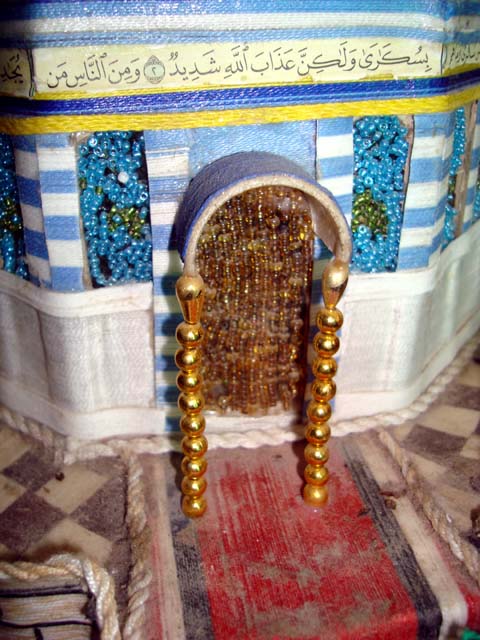
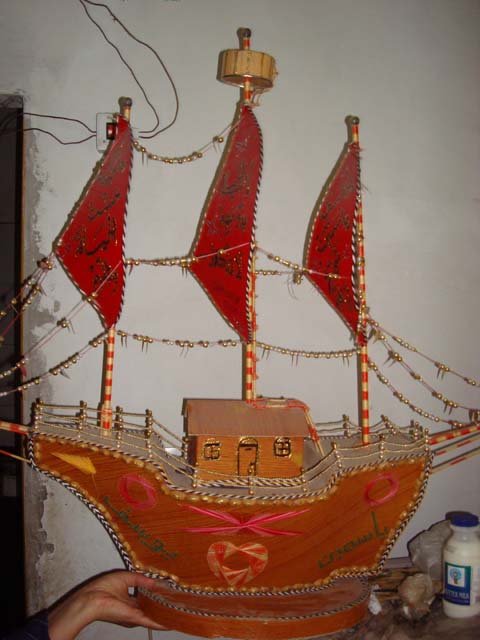
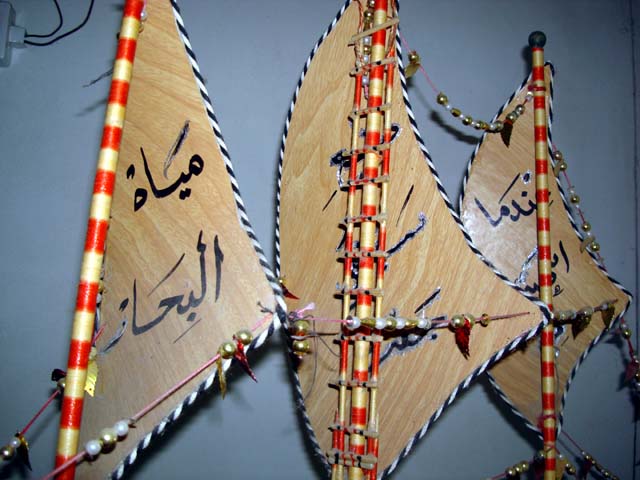
His home is filled with crafts made in prison –pillows, embroidery, even a multi-sailed sailboat, all branded with words of love for his wife and children.
“Riham is so strong, I’ve loved her since I was in my mother’s womb,” Anwar said adoringly of his wife, pointing to the embroidered initials ‘AR’–Anwar and Riham–which appear on many of the different crafts he made.
“This is al Khoba al Sakhara, the Dome of the Rock,” he explained, displaying a model of the revered golden dome in the al Aqsa mosque complex in Jerusalem, one of the most important sites for Muslims. Palestinians with Gaza or occupied West Bank ID cards are largely cut off from the holy site, particularly at crucial times, like the religious festivals of Eid. By nature of their West Bank IDs, even during non-holy times of the year, Palestinians outside of Jerusalem (and even those within Jerusalem at times) find it nearly impossible to visit the mosque.
Released three years later, Anwar finally re-aquainted with Riham and their children, including the son he had yet to meet.
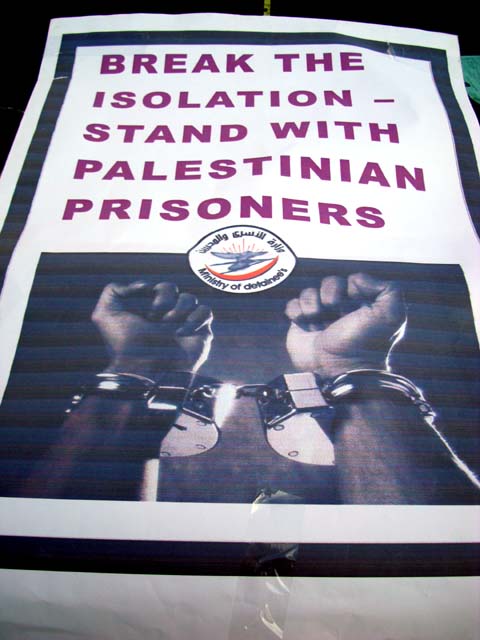
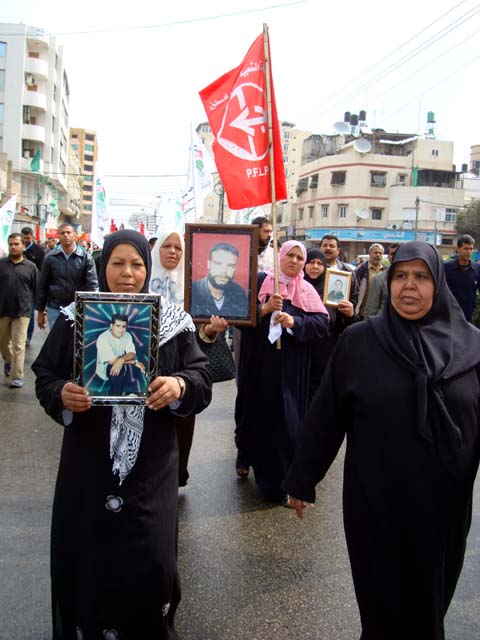
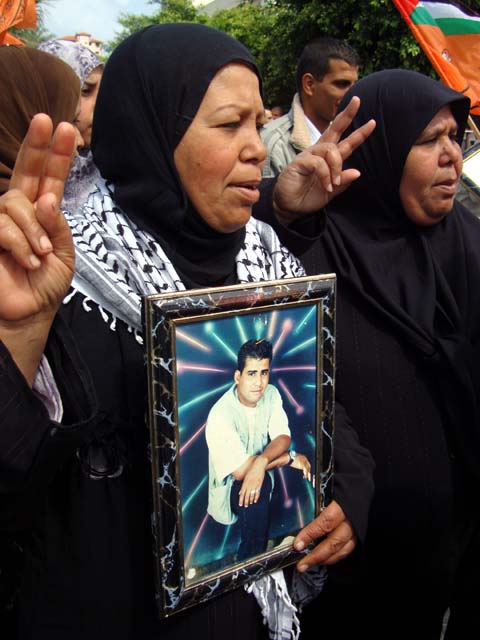
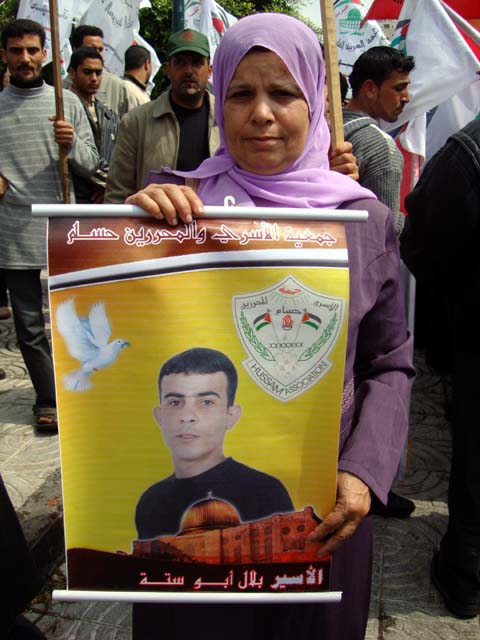
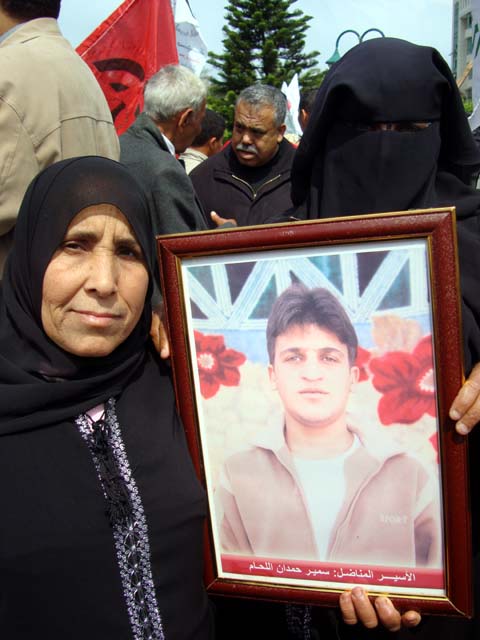
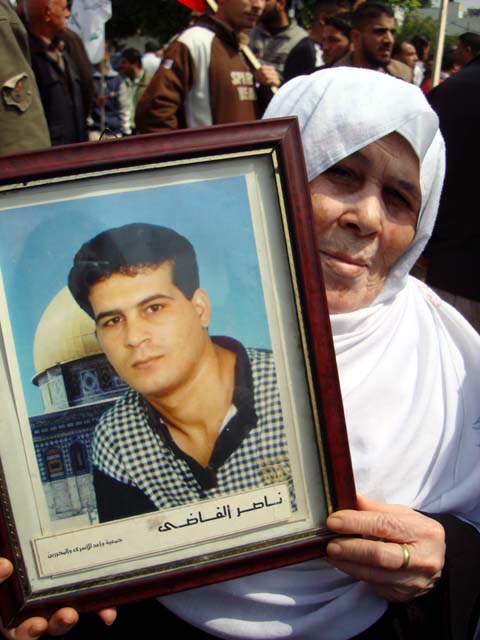
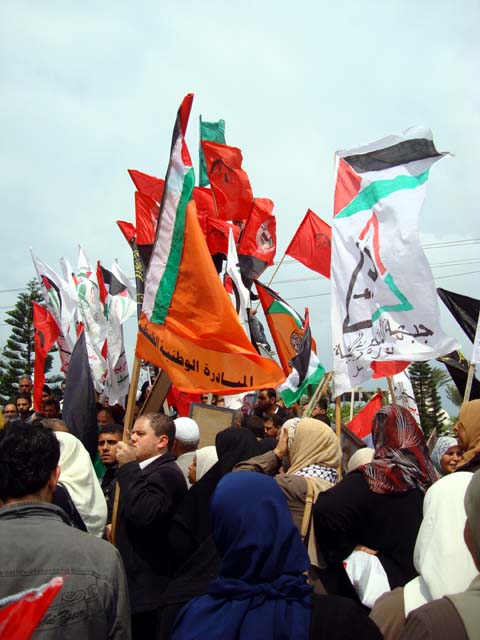
Two days prior to visiting Anwar, in Gaza’s demonstration on Palestinian Political Prisoners’ Day I saw a blur of faces — mothers, wives, children–holding posters or small photos of their imprisoned loved ones. In Gaza the situation for political prisoners as well as their families has become unbearable, with visitation rights fully terminated, meaning families have gone one year, five years, or more, without seeing or talking with their imprisoned loved ones.
The Palestinian Centre for Human Rights (PCHR) describes how visitation rights have become worse to impossible after Israel began employing the term “enemy/illegal combattant” in reference to imprisoned Palestinians from Gaza:
Israel began to utilize the contested “illegal combatant” concept with respect to Gazan prisoners. The use of this concept grants the Army Chief of Staff the power to issue an arrest warrant against whoever it considers an “illegal combatant”. Classification criteria is determined by the Army Chief of Staff and the disclosure of evidence is not required.
Palestinian Political Prisoners’ Day honours the nearly 11,000 Palestinians, including 349 minors and 75 women (as of October 2008 ICRC statistics) held in Israeli jails and under the nefarious “administrative detention” category which enables Israel to hold prisoners indefinitely without sentencing them. Israeli rights group B’Tselem says:
Administrative detention is intended to prevent the danger posed to state security by a particular individual. Israel, however, has never defined the criteria for what constitutes “state security.”
Israel’s use of administrative detention blatantly violates these restrictions. Over the years, Israel has held Palestinians in prolonged detention without trying them and without informing them of the suspicions against them. While detainees may appeal the detention, neither they nor their attorneys are allowed to see the evidence. Israel has therefore made a charade out of the entire system of procedural safeguards in both domestic and international law regarding the right to liberty and due process.
As of February 2009, Israel is holding more than 560 Palestinians in administrative detention in facilities run by the Israel Prison Service (IPS).
Recognizing the thousands of unjustly imprisoned Palestinians, in and outside of Palestine, solidarity supporters held demonstrations calling not only for their release but for conditions within Israeli-run prisons to meet the minimum standards internally-recognized for prisoners, something which PCHR succinctly notes Israel consistently falls far short of, listing among many concerns on the treatment of Palestinian prisoners:
• Ill-treatment and poor detention conditions
Palestinian prisoners are detained in below minimum standard conditions. They are detained in narrow, overcrowded and poorly ventilated cells. Israeli jails dedicated for the detention of Palestinians lack necessary sanitation facilities, and Palestinian prisoners are denied access to personal cleanliness and hygiene. Israeli prison administrations do not provide enough food, in terms of quantity and quality, for the Palestinian prisoners. Detained Palestinian children and patients do not get food suitable to ensuring their physical wellbeing.
• denying visitation rights
IOF deny Palestinian prisoners their visitation rights via the imposition of different conditions that hinder or prevent visits of Palestinian families to their relatives in Israeli jails. These conditions include: linking visitations with the overall security situation, requiring that prisoners must not be security prisoners and that persons applying for visits must not have a security record, requiring that visitors be first-degree relatives and that brothers or sons applying for visits must be under the age of 18. Since 6 July 2007, families in Gaza have not been able to visit their relatives in Israeli jails.
• Medical negligence and denial of healthcare
Due to poor detention conditions, hundreds of Palestinian prisoners are suffering ill health. Israeli jails lack specialized medical personnel and clinics. Israeli prison administrations have consistently refused the provision of medicines and medical equipment necessary for the treatment of some sick prisoners. In addition, these administrations ignore the dietary requirements of some detained patients.
• Torture
IOF subject Palestinians detained in Israeli prisons to numerous instances of torture, and cruel, inhuman and degrading treatment. Apart from using poor detention conditions as a means to exert psychological pressure and cause physical weakness, IOF also mistreat Palestinian detainees in order to extract confessions. Known methods include: preventing detainees from meeting with their lawyers, beatings, verbal abuse and insults, threats, the use of Shabhah, sleep deprivation, forcing detainees into the ‘frog crotch’ and the ‘banana’ positions, tightening handcuffs and shackles around hands and legs, suspending by legs, and so on. The isolation of prisoners in poorly-ventilated solitary confinement cells, where they are denied visitation rights and contact with other prisoners, is one of the cruelest punishments applied to Palestinian prisoners. Solitary confinement cells are narrow, poorly ventilated and highly humid; conditions that facilitate the spread of diseases.
IOF violations of Palestinian prisoners’ rights constitute serious violations of International Humanitarian Law. In particular, ill-treatment of prisoners, denial of visitation rights, medical negligence, torture and administrative detentions are violations of the Fourth Geneva Convention of 1949 relative to the protection of civilians in times of war, and against the United Nations Standard Minimum Rules for the Treatment of Prisoners.
useful sites on Palestinian political prisoners:
Monday, April 13, 2009
First Call out of the International Campaign of Solidarity with the Palestinian Prisoners
Dear everyone,
Please take a few minutes to read the call-out below from a broad
Gaza-based prisoner solidarity campaign made up of a coalition of
prisoner rights groups, local and international activists, prisoner
families and Ministry of Detainees
representatives in Gaza.
Friday April 17th is the international day of solidarity with
Palestinian prisoners. Just over 11,000 are behind bars in occupation
prisons inside the apartheid lines and outside the ghetto walls of the
West Bank and Gaza.
Prisoners are a community under siege which represents every faction in
Palestine. Solidarity between prisoners inside Israeli jails crosses all
political borders. They have sacrificed their individual freedom for
collective freedom.
From taking direct action to symbolic gestures (in the case if prisoner
campaigns, simple visual solidarity gestures drawing public attention to
the struggle of prisoners is always effective in keeping memories,
spirit and solidarity alive). Please take action this week! And email us
about it...
palestinianprisoners@gmail.com
http://palestinianprisoners.blogspot.com
April 17th is the international day of solidarity with Palestinian
prisoners. These over 11,000 men, women and children are ghost
prisoners, forgotten by the international community and media which has
focused on the systematic and physical psychological torture of
prisoners in high profile camps such as Guantanamo Bay but has largely
ignored the network of Israel's 'Guantanamos' inside 'Israel'.
This call comes from Gaza – recognized as a large open air prison and
place of punishment and exile for Palestinian prisoners from the West
Bank.
Maximum security facilities such as Nufha, Haderim, Jalamy, and Ashkalon
, and so-called 'black sites' which the Israeli government refuses to
aknowledge, hold thousands of Palestinian prisoners. These prisoners are
regularly and systematically tortured, denied access to legal
representation, family visits, education, shelter, light, essential
medical care and medicines.
The 'Israeli state' has a policy of administrative detention which means
any man, woman or child can be arrested at any time and in any place and
incarcerated without trial or access to any alleged evidence held by the
intelligence services, for an undetermined and extendable length of
time.
The majority of Palestinian men have been and will be arrested and
incarcerated at some point in their lives by Israeli occupation forces.
Under the Fourth Geneva Conventions, which Israel is a signatory to,
Palestinian prisoners should be treated by the occupying forces under
the rules applicable to the treatment of civilians in time of war.
Almost all the Palestinian detainees are held in jails away from the
West Bank (including East Jerusalem) and Gaza Strip, in violation of
international humanitarian law, which bars the removal of detainees to
the territory of the occupying power. The 'Israeli' military and
security forces regularly violate international law and conventions
relating to prisoners.
Imprisonment and torture is an intergenerational experience for
Palestinians living in Gaza, 1948 Palestine ('Israel') and the West
Bank.
Imprisonment is a core element of the Israeli occupation's strategy of
collective containment and punishment of the Palestinian population –
both of those jailed, and their families who suffer their absence and
wait for their release. Military resistance fighters, as well as
non-militarily active political activists, community organizers,
paramedics, doctors, journalists, teachers, and students are regularly
jailed under an Israeli legal framework which criminalizes any form of
resistance to occupation.
The inhumane prison conditions that Palestinian prisoners endure are
steadily deteriorating. Following the Gaza massacres, the collective
punishment of prisoners from Gaza has accelerated, with prisoners being
denied the right to newspapers, radios, phone calls and visits from
legal representatives. Gazan prisoners are now being confined to their
cells for up to 23 hours a day and are being classified as "enemy
combatants" further stripping away any rights to legal defence.
Palestinian prisoners are a forgotten community behind bars, often
locally referred to as 'living martyrs'. The prisoner issue is a core
part of the Palestinian struggle, whose liberation is as integral to the
struggle for justice and peace as the return of refugees, Jerusalem and
stolen land.
In Gaza we will be holding a week of activities in solidarity including
a marathon through the streets of Gaza in solidarity with our jailed
loved ones, a conference of all prisoner advocacy organizations and
prisoners' families, a mass demonstration and a celebration of
Palestinian resilience, sacrifice and patience.
In the light of 'Israel's' further shift to the far right, unchallenged
impunity, and the intensified humiliation of Palestinian prisoners, we
call on the international community to take a stand.
We call for an end to double standards and for international pressure to
force 'Israel' to adhere to international law.
We call on national representatives, parliamentarians, human rights
organizations, trade unions, activists and people of conscience
throughout the world to recognize, remember, speak out and protest the
treatment of Palestinian prisoners this week.
We hope this week will be the catalyst that sparks long-term campaigns
and commitments towards solidarity with Palestinian prisoners.
http://palestinianprisoners.blogspot.com
palestinianprisoners@gmail.com
Thursday, April 9, 2009
Unlawful Combatants The Violation of Gazan Detainees' Rights in Israeli Prisons
This report aims to give the reader an understanding of the legal status of unlawful combatants within international law as well as Israeli and US law. It examines Israel's Incarceration of Unlawful Combatants Law, 5762-2002 (with amendments passed on 30 July 2008), as a way of abrogating the rights of Palestinian detainees in Israeli prisons. The report compares the policies of Israel towards unlawful combatants' detainment to those of the United States. Ultimately the report examines the international community's obligation to condemn the current policies, which directly violate international humanitarian law and international human rights law, in the way that the US policies have been criticized.
Download FileMonday, March 30, 2009
The tragedy of the Palestinian Prisoners

Torture and ill treatment include: