Thursday, March 18, 2010

Detainees: Nafha prison among worst

Gaza – Ma'an – Detainees at Israel's Nafha jail say their conditions are among the worst in the Israeli prison establishment, the Husam detainees center reported Thursday.

Prisoners sent a message on Wednesday night, Husam reported, telling officials that sick detainees are neglected and others are transferred from one prison to another.

The Husam center said detainees are consistently complaining about poor treatment in the prisons, especially the Nafha prison, but rarely receive the backing and support they need.

Jailed Fateh Leader Gets PHD

Wednesday March 17, 2010 08:00 by Saed Bannoura - IMEMC & Agencies

Imprisoned Fateh leader, Marwan Barghouthi, serving five consecutive life terms in Israeli prisons, obtained his PHD degree in Political Science.
Archive Photo of Barghouthi - Donia Al Watan
Israel kidnapped the Palestinian official, an elected legislator, and accused him of forming the Al Aqsa Brigades, the armed wing of Fateh, and held him responsible for the death of several Israelis.

Barghouthi, 50, joined the University of Cairo and the Arab Academy for Research and Studies in 1999, just three years before Israel arrested him.

His thesis “The Legislative and Political Performance of the Palestinian Legislative Council (PLC) and the Contribution of the PLC to the Democratic Process in Palestine in the period between 1996 and 2008.

His theses, 341 pages, will be presented to the Dead of the Arab Academy for Research and Studies, Ahmad Yousef.

The Jerusalem Post reported that Barghouthi managed to obtain the needed books and materials authorized by the Israeli Authorities.

It is worth mentioning that in 1980, Barghouthi managed to obtain his high school certificate while he was imprisoned by Israel. After completing school and being released Barghouthi obtained his B.A degree and masters from the Bir Zeit University near Ramallah.

The Fateh leader was brought in front of an Israeli court and was convicted on May 20, 2004.

Israel claimes that Barghouthi organized attacks that led to the death of 21 Israelis.

On June 6, 2004, he was sentenced to five life-terms and 40 years. Barghouthi is a Palestinian leader who enjoys wide respect and support from the Palestinian people regardless of their political affiliation. He is seen as a symbol for resistance, determination and steadfastness.

Female detainees moved to cell 'where human beings cannot live'

Gaza – Ma'an – Fifteen female detainees at the Damon detention center in Israel were transferred to a new section that falls well below required standards, the Detainees Support Committee said.

Committee spokesman Riyad Al-Ashqar said the new sector "is a place where human beings cannot live, particularly during the winter. There are no windows, no doors, and electricity wires remain uncovered, which could potentially cause a fatal accident when it rains."

Al-Ashqar added that the cells lack hot water and heaters, with no bathrooms. "The toilets are public and outside the cells. The women have limited and restricted times when they are allowed to use the facilities," he said, describing the kitchen as "poor."

The spokesman further said detainee Wafa' Samir Al-Lubs from the Gaza Strip was permitted to speak to her family over the phone for the first time since her detention, where she congratulated her sister on her recent wedding.

According to the committee, Al-Lubs has been placed in solitary confinement for five months, a move he deemed a "threat to her life."

Wednesday, March 17, 2010

Fatah detainee released after 18 years

Gaza – Ma'an – Israeli authorities on Tuesday night released detainee Atef Mhanna of Khan Younis after 18 years in prison.

The Fatah movement in central Khan Younis congratulated Aref on the occasion of his release, and called for more prisoners to be freed.

Tuesday, March 16, 2010

Abu Hasana spent two thirds of his life in prison

[ 16/03/2010 - 09:53 AM ]


GAZA, (PIC)-- Palestinian prisoner Iyad Abu Hasana, 36, has spent two thirds of his life in Israeli captivity, the higher national committee in support of prisoners said on Monday.
The committee in a statement said that Abu Hasana was arrested on 15/3/1989 and was sentenced to 30 years in jail when he was only 15 years old on charge of storming an Israeli military base near the borders between Gaza and Egypt.
It noted that the Israeli prisons authority (IPA) was holding Abu Hasana in solitary confinement for the past five years and only a month ago it moved him to a new isolation jail, which is not known so far.
Abu Hasana has been deprived of family visits for the past eight years, the committee said, adding that the IPA refused to allow the Red Cross to send him clothes.
Ibrahim, the prisoner's brother, expressed concern on the life of Abu Hasana after moving him to an unknown isolation, adding that this brother was suffering psychological disturbances due to his long time of isolation and constant transfer from one prison to another.
He appealed to human rights groups to intervene and save the life of his brother. He asked for ending his brother's isolation and releasing him to receive proper treatment before further deterioration of his condition.

Gaza detainee marks 21 years in Israeli prison
 
Published Monday 15/03/2010 18:09
 
Gaza – Ma'an – A Hamas affiliated prisoner from Rafah, southern Gaza, marked 21 years in Israeli custody on Monday, the Supreme National Committee said.

Iyad Ahmad Abu Hasnah, 36, was detained on 15 March 1989 and sentenced to 30 years. He was detained when he was 15 for driving into an Israeli military zone on the border between Gaza and Egypt, the committee said.

Abu Hasnah spent the last five years of his sentence in solitary confinement, the committee said, adding that the Israeli Prison Service had refused to transfer him to a regular cell. The detainee has been banned from receiving family visits for eight consecutive years, the committee added.

His family told the committee that they are afraid for his well being and called on international human rights groups to intervene in the matter.

Palestinian prisoners intend to take steps in protest at Israeli abuses

[ 15/03/2010 - 04:29 PM ]


NABLUS, (PIC)-- The Palestinian prisoners in Israeli jails declared their intention to take a number of steps next April in protest at the Israeli violations against their rights.
In a joint statement, the prisoners highlighted that the Israeli violations against them went too far and escalate, affirming that many of them especially those from Gaza are still deprived of their right to family visits under flimsy security pretexts, while their families are exposed to maltreatment and humiliation at military checkpoints.
The statement highlighted many of the violations committed against them in Israeli jails including the policy of medical neglect and solitary confinement.
It added that the prisoner decided, after their patience towards these abuses ran out, to move and rise up in defense of their rights and dignity.

Sunday, March 14, 2010

Sent to jail for throwing a single bottle

Last year, during protests against the attack on Gaza, a mixed group of demonstrators clashed with police. But when the alleged culprits were arrested in dawn raids, nearly all those taken were young Muslims
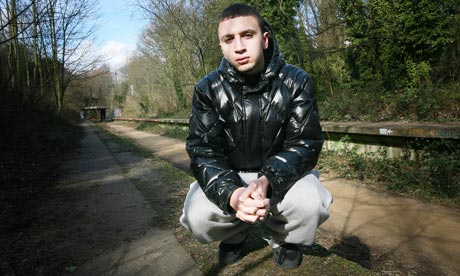
Gaza protester Yahia Tebani
Yahia Tebani, is awaiting sentencing. 'If I’ve got "ex-prisoner" on my file, how am I going to get a job?' Photograph: Anna Gordon
Badi Tebani and his wife were sleeping peacefully when all hell broke loose. He shudders at the memory. The front door was forced open, and then came the screaming. "Wah, wah, wah, get down, get down, you are under arrest." Any number of voices. He thought it was a nightmare – that he was back in Algeria in the bad old days before he was granted political asylum in Britain, and that the military had broken into the house. When he opened his eyes, his bedroom was full of police officers. "I have diabetes and high blood pressure," he says quietly. "It was worse than Algeria, even. I became very depressed."
It was 5am, April 2009. Badi's eldest son Hamza, 23, takes up the story. "I woke up and tried to get out of bed. The next thing is three police officers jump on top of me with their knees, and they handcuffed me so hard I screamed. That's when I really woke up." Hamza had been sleeping in shorts. When he asked if he could put a shirt on the police said no and opened the window. "It was freezing. I was shaking."
His three brothers, the youngest of whom was 15 at the time, were also handcuffed. Hamza says there were too many officers to count – somewhere between 20 and 30. They took computers, clothes, iPhones, everything. "I've never been in trouble, never been to the police station except when my car was broken into, and they were treating me as a criminal. One of the officers was playing card games with my iPhone, another was just ordering coffee."
Badi, an Arabic teacher, tuts. "They make our house into a coffee shop."
But it wasn't Badi or Hamza the police were after. It was Yahia, one of Hamza's younger brothers. When Yahia heard that the police were looking for him he was confounded. "I didn't know why they were there, and then I hear my name and I'm shocked."
Three months earlier, in January last year, Yahia had been outside the Israeli embassy on a fractious demonstration against Israel's sustained bombing of Gaza. The British foreign secretary, David Milliband, had condemned the "unacceptable" loss of life caused by the Israeli strikes on Gaza, saying the "dark and dangerous" events could fuel extremism, and had called for an immediate ceasefire from both Israel and Hamas.
Protesters complained that the demonstration was policed provocatively and that they had been "kettled" inside a tunnel and beaten. Meanwhile, the police complained that they had been assaulted by demonstrators.
Yahia, 18, says both accounts are true. He claims that the policing was aggressive and intimidatory, and that demonstrators responded by throwing sticks and bottles at the embassy and the officers, who were wearing full-body shields. Yahia picked up a few sticks from discarded banners and flung them in the direction of the police. He was one of approximately 50,000 demonstrators, many of whom threw objects. It was a mixed bunch – white and black, Muslim and Christian, Stop the War Coalition, CND, all sorts. This was one of a number of Gaza demonstrations covered on television news, and it was reported there had been some trouble – but nothing on the scale of, say, the G20 protests or the poll tax riots.
Yahia, who was studying media technology at Kingston University, had gone on the march for two reasons – to protest, and to interview fellow demonstrators for a project on Gaza. The crowd was held by the police for four hours and eventually released. Some people were filmed and had to give their name and address to the police, some were arrested. Yahia simply left of his own accord, and eventually got home at midnight.
He told Hamza it had been a difficult day, it had given him plenty of food for thought, and that was that – until the police broke into the family home in Finsbury Park, north London, three months later. Yahia was arrested in March and charged with violent disorder and burglary – at one point during the demo, he says, he had taken a chair from the nearby Starbucks to sit on, but police reports said the Starbucks was trashed and mugs and chairs were used as weapons. He was advised that the burglary charge would be dropped if he pleaded guilty to violent disorder, for which he would probably receive a suspended sentence or community service. He thought a lesser charge of affray would have been fairer, but agreed to the compromise. "It would always look bad in the future if it says burglary. People won't know what really happened, so I couldn't risk that being on my file."
What Yahia didn't realise was nearly all the protesters who pleaded guilty to violent disorder would end up receiving immediate prison sentences. His friend Sidali is serving two years. Yahia was in court the day Sidali was sentenced. "He didn't even throw sticks," he claims. "He just pushed or something, and his clothes were ripped a bit. In court he was crying. The shock on his face, I've never seen anything like that. Pah!" He blows his lips together in dismay.
Yahia is to be sentenced this month. How's he feeling? "Stressed. Pah. Just waiting to go in. I've been asking my friend what it's like. He says time goes quick – he doesn't want to scare me."
It's not just the prospect of prison that terrifies him, it's what comes after. "If I've got 'ex-prisoner' on my file, how am I going to get a job? It will destroy my career."
At Isleworth crown court in London, where the cases are being heard, a disturbing pattern is emerging. Most of the 78 protesters charged with public order offences were young men in their late teens or 20s. Many were students. And nearly all were Muslim. Some 22 protesters have already received prison terms of up to two and a half years for public order offences, and more cases are due to come before the courts in the coming months.
The Gaza Protesters Defence Campaign has been formed by the families of some of those arrested, together with sympathetic MPs, the Stop the War Coalition and CND. The campaign aims to highlight the perceived injustice, and has launched a petition which will be presented to the attorney general and the director of public prosecutions.
Earlier this month, families queued up outside committee room 15 in the House of Commons for a campaign meeting. Many feel bewildered by the sentences the courts have passed on their sons and daughters, brothers and sisters. When Joanna Gilmore, a researcher at the University of Manchester's law school who has monitored the cases, gets to her feet the room is already full, and latecomers are forced to listen from the corridor. "The vast majority of the people involved here are of exemplary character," she says, to mutters of approval. "The demonstrations were overwhelmingly peaceful and if you compare the relatively minor disturbances that took place with the violence on other demonstrations these sentences are very severe."
Gilmore, who has followed all the court cases, says the police arrested more people at the Gaza protests than at any political demonstration since the poll tax riots, when about 90 were charged with public order offences. At last year's G20 demonstrations, during which a branch of the Royal Bank of Scotland was looted, 20 were charged.
"Many were on their first demonstration and were protesting because they were appalled about what was happening in Gaza," Gilmore says. "These people and their families are in shock and say that they will never take part in political demonstrations again."
Bruce Kent, a former general secretary of CND and long-time peace activist, gets to his feet to address the packed meeting. Kent, 80, had been on the demonstration and says he was "amazed and indignant" about the reaction of the police and the courts.
"I don't know why there isn't absolute outrage … All this will do is solidify in people's minds the idea that there is a persecution of Muslims which is determined and organised and will result in some young people being radicalised."
He says there is a huge discrepancy in the way different people are treated by the law, and recalls a time in 1986 when he had been convicted of criminal damage after cutting a wire fence during a protest at a nuclear base. "I was in the crown court waiting with my toothbrush packed. I thought I was off to one of her majesty's holiday camps. Not at all, not even a fine. Why? Because I am middle-class and white."
Like Yahia Tebani, 24-year-old Ashir was in bed when the police raided her west London flat at 4am. The strange thing is, she says, her brother, who is due to be sentenced for his part in the demonstrations this month, has never been interested in "politics or religion" and only joined the protest because he was at his cousins' house when they decided to go.
Although Ashir says her younger sibling did not throw any missiles, she admits he did protect himself when the "police people started fighting". He left as soon as he could, giving his details to officers. Two months later the police made their unannounced visit.
"We heard a disturbance at the neighbour's flat first and I heard loads of banging and shouting," she says. "I looked out of the window but no one had police uniforms on so I didn't know what was happening. A few minutes later when we were getting back into bed we heard people running up the stairs and then our door burst open. I was so scared because I had no idea what was happening or who these people were."
Every detail chimes with Yahia's experience – the family were handcuffed for two and a half hours, Ashir only had her nightclothes on and was not allowed to get dressed and her computer was taken. "They said I may have weapons in the house, but I didn't understand – what weapons could I have? I am not a criminal. They went through everything. They said they were looking for evidence, for clothes that my brother had been wearing on the demonstration. They took my laptop which had my university dissertation on spa tourism on it because they said he had had access to it. I asked if I could at least email the dissertation to myself but they said I wasn't allowed to touch it. I still have not got it back almost a year later even though I keep asking for it. I had to start my dissertation from where I had last saved it on a uni computer."
Ashir, who does not want to give her real name because she fears going public might result in her brother being given a bigger sentence, still has panic attacks about what happened that night. "I am scared if I see any police anywhere. Even if I was angry about something I would never go on a demonstration now because I have seen what can happen."
Muhammad Sawalha, president of the British Muslim Initiative anti-racist group, has two questions: why were such a high proportion of those arrested Muslim, and why have they been dealt with so heavy-handedly?
Actually, Judge John Denniss has been quite clear about sentencing policy. He has said, more than once, the draconian sentences are meant to act as a deterrent to future protesters. But, because of the fact that the people being brought before the courts are disproportionately Muslim, Sawalha says, the consequences could be disastrous: "The British Muslim Initiative encourages Muslims to express their feelings and ambitions and frustrations only through political and legal processes. But if anything sends the message that Muslims cannot express themselves through political processes, and they will not be dealt with like others, it will give more strength to the fringes within the community who say democracy and the political system doesn't apply to Muslims in this country. This will only increase the frustration and sense of alienation among these people."
Dr Khalil al-Ani says his son Mosab was one of the lucky ones. There was no pre-dawn raid, no handcuffs, no ransacking. He was simply asked to surrender his passport to the police. Months after throwing an empty Orangina bottle – the police said it was at them, Mosab said it was at the Israeli embassy gates – he was charged. Mosab, who was on a medical access course, hoped to be a dentist or dental technician. He is now in prison serving a one-year sentence.
It was the first demonstration Mosab had been on since his family marched against the Iraq war in 2003. Al-Ani, an Iraqi who works as a GP in Wakefield and Leeds, was pleased his son would be on the march. His two sisters were also going, and Al-Ani felt Mosab, then 20, would protect them.
Mosab was arrested on the day and taken to a police station where he admitted throwing the bottle, apologised, and stressed that he had not aimed it at the police. He was released and returned to Yorkshire, but didn't tell his father what had happened – he didn't want to worry him, and he assumed it was the last he would hear of it.
"He didn't think it was serious because how many times have you seen something like this or more serious, and nothing happens." Al-Ani stops, and apologises for his tears. "I'm sorry I get so emotional. I came to this country in 1981. You can hear by the way I speak my accent is not purely British. It is a foreign accent after all these years. But Mosab was born here in 1988 – he is British in every sense. This is the first time I feel that because he's a Muslim he's been discriminated against. What he did was certainly wrong, but he should be treated similar to a British citizen. He's gone to prison for a single bottle that didn't hurt anybody."
The astonishing thing is, he says, that the judge gave Mosab a flawless character reference. "He said, 'I know you came here peacefully, I know you have an excellent character, I know you were not armed, you said sorry to the police.'" He was sure his son would go free. "I was so pleased. Then the judge says, 'I'm going to give you this sentence to deter other people.'"
Back in north London, Badi Tebani is looking at the door the police forced open. As they left the house, they made a point of telling him it was still in one piece. "When they finished their work, the police officers show me the door and say, 'It's not broken, look, look,' and they took a photograph. I told him, it doesn't matter if you broke the door, you broke my life."

PCHR weekly report 4/3 - 10/3/10: 17 Palestinians arrested including 2 children

extracts from PCHR weekly report 4/3 - 10/3/10:

At least 800 Gazan prisoners in Israeli jails have been deprived of family visitation for more than two and a half years.

  In recognition of ICRC as the guardian of the Fourth Geneva Convention, PCHR calls upon the ICRC to increase its staff and activities in the OPT, including the facilitation of family visitations to Palestinian prisoners in Israeli jails.

IOF arrested 3 Palestinian fishermen from the Gaza Strip and confiscated their boat.

IOF arrested 14 Palestinian civilians, including two children.

Thursday, 04 March 2010 

· At approximately 01:30, IOF moved into 'Obwin village, northwest of Ramallah. They raided and searched a house belonging to the family of Fareed Murshed Khayat, 20, and arrested him.

· Also at approximately 01:30, IOF moved into Housan village, west of Bethlehem. They raided and searched a house belonging to the family of Mos'ab Ahmed Za'oul, 21, and arrested him. 

At approximately 02:30, IOF moved into al-Yamoun village, west of Jenin. They raided and searched a number of houses and arrested 'Othman 'Ali Zayed, 25.  

Also at approximately 02:30, IOF moved into Kufor Dan village, west of Jenin. They raided and searched a number of houses and arrested Nasser 'Adnan 'Aabed, 20. 'Aabed was released a few hours later, having been interrogated by IOF. 

Friday, 05 March 2010

· At approximately 02:30, IOF moved into al-Ymoun village, west of Jenin. They raided and searched a number of houses and arrested Tamer Suleiman Abu Toul, 21.

· Also at approximately 02:30, IOF moved into 'Aanin village, west of Jenin. They raided and searched a number of houses and arrested Mohammed 'Awadh Mansour, 26.

· At approximately 03:00, Israeli naval troops opened fire at a small Palestinian fishing boat 500 - 700 meters from Rafah beach in the southern Gaza Strip. They then surrounded the boat and forced the fishermen on board to take off their clothes and swim towards the gunboat. Israeli naval troops arrested the fishermen and confiscated the boat. The fishermen were released at approximately 16:30 on the same day. They are: Nafez Mohammed al-Aqra', 39; Mohammed Nabeel al-Aqra', 22; and Mohammed Mohammed al-Aqra', 20. 

Saturday, 06 March 2010

· At approximately 01:00, IOF moved into Beit Ummar village, north of Hebron. They raided and searched a house belonging to Muntasser Diab 'Awadh, 21, and arrested him.

Sunday, 07 March 2010 

At approximately 02:00, IOF moved into Til village, southwest of Nablus. They raided and searched a number of houses and arrested Bassel Yousef Ramadan, 18.  

Monday, 08 March 2010

· At approximately 01:00, IOF moved into al-Sheikh quarter in the center of Hebron. They raided and searched a number of houses. They arrested Islam 'Abdul Latif al-Harbawi, 19, and confiscated his mobile phone and computer set.

· At approximately 02:00, IOF moved into 'Anata refugee camp near Jerusalem. They raided and searched a house belonging to the family of Mousa Ibrahim Salama, 24, and summoned him for interrogation. 

Tuesday, 09 March 2010

· At approximately 01:00, IOF moved into 'Ein Sarah and al-Zahed neighborhood in Hebron. They raided and searched a number of houses and arrested two Palestinian civilians:

1. 'Allam Mohammed Dandis, 27; and
2. Bassam Robin al-Adhami, 28.

· At approximately 01:30, IOF moved into Housan village, west of Bethlehem. They raided and searched a number of houses and arrested two Palestinian children:

1. Hamza 'Abdullah Shousha, 16; and
2. Muntasser Mohammed Za'oul, 17.

Wednesday, 10 March 2010

· At approximately 08:30, IOF moved into Rummana village, west of Jenin. They established a checkpoint at the entrance of the village. They stopped and searched Palestinian civilian vehicles and arrested Mohammed Kamel Eghbariya, 25.

Israel detains 5 Palestinians without food for 48 hours

 
ki99_copy_copyRamallah, March 14, 2010 (Pal Telegraph) - Palestinian sources revealed today that Israeli occupation forces detained five Palestinians from the village of Nabi Saleh in Ramallah for 48 hours.
The IOF handcuffed their hands and did not give the Palestinians any food or drink. The sources said that the five detainees kidnapped from their homes in the early morning, including four brothers, were: Uday , Loay, Majed and Mustafa Al-Tamimi and Tammen Al-Tamimi. All of them were taken to Halmish camp near the town, and then to Benjamin camp near Ramallah.
The IOF beat them while transporting them to Ofer Prison, then questioned them about throwing stones. The men denied that accusation.

Saturday, March 13, 2010

Soldiers Attempt to Strip-Search Five Palestinian Women

Tuesday March 09, 2010 23:58 by Saed Bannoura - IMEMC News

Five Palestinians women preferred to go home rather than heading to an Israeli prison to visit their detailed family members after Israeli soldiers stationed at a Roadblock near the central West Bank city of Ramallah demanded to strip-search them.
File - image oujdacity.net
Qaddoura Fares, head of the Palestinian Prisoner Society, stated at a press conference on Tuesday that this is one of the illegal means Israel is using to target the detainees and their families.

He added that the families of the detainees decided to strike for a month in April to protest the illegal Israeli measures. They will not be visiting their detained family members and would be holding protests in front of the Red cross.

Israel is also denying 1200 detainees from any visitations as they are classified as “security risk”.

Fares called on all factions and different institutions to participate in the strike and to highlight the issue of the detainees and their plight in Israeli prisons.

Palestinian Minister of Detainees, Issa Qaraqe’, said that Israel is always trying to strip-search the families of the detainees, especially the women, and that such demands are mainly made at the prisons.

He added that this is a direct violation to the Fourth Geneva Conventions, and all related human rights laws.

Qaraqe’ said that women and children are subjected to humiliation by the soldiers at different roadblocks, and are asked to strip in order to be searched, an issue which pushes them to return home instead of continuing their way to visit their detained family members.

He further stated that the strike comes in solidarity with the detainees from the Gaza Strip as their families were not able to visit them since more than three years.

Dozens of detainees are deprived from perusing education in prison, while Israel is also not allowing the entry of books, educational materials and even clothes.

Imprisoned Qassam Leader Calls For Capturing More Soldiers

Tuesday March 09, 2010 12:10 by Saed Bannoura - IMEMC & Agencies

Abdullah Barghouthi, imprisoned leader of the Al Qassam Brigades, the armed wing of Hamas, stated that the solution to the issue of thousands of detainees imprisoned by Israel is by capturing more Israeli soldiers to trade them with Palestinian detainees.
Qassam Barghouthi
Qassam Barghouthi
Barghouthi stated the Israeli prisoner of war, Gilad Shalit, will never be released as long as Israel is holding Palestinian prisoners captive.

He said that “the only solution is capturing more Israeli soldiers”, and added; “I am responsible for my statements, I do not fear the darkness of prison”.

Barghouthi accused Israel’s Prime Minister, Benjamin Netanyahu, of sabotaging all efforts to achieve a prisoner swap deal.

He stated that the father of Shalit knows that Netanyahu is the one who foiled the swap deal “but is afraid to speak out”. Barghouthi added that the Israeli negotiator, Haggai Hadas, signed a list that was provided by Hamas but Netanyahu backed down.

His name was the third of the list after the names of Fateh leader, Marwan Barghouthi, and Ahmad Saadat, secretary-general of the Popular Front for the Liberation of Palestine.

Abdullah Barghouthi was born in Kuwait in 1972, a married father of three children. He holds Jordanian citizenship and is known as the Engineer of the Al Qassam Brigades. He was sentenced by an Israeli court to 67 life-terms and is currently imprisoned at the Be’er Sheva prison.

The Palestine-Info news website, affiliated with Hamas, reported that Al Barghouthi entered the West Bank in 1999 to visit his relatives in Beit Reema, near Ramallah. He then joined the Al Qassam Brigades.

Referring to the issue of Mosab Yousef, the son of Hamas leader, Hasan Yousef, who became a collaborator with Israel and claimed to be behind the arrest of Barghouthi, the detained Hamas fighter said that “the person who is behind my arrest in now buried under the ground”.

He underestimated the damage caused by the collaboration of Mosab, and said that the Al Qassam Brigades refused to allow him to be one of its members after he failed certain tests defined by the group as a condition for membership.

He also stated that the claims of Mosab that showed him as the person who saved the life of Israel’s President, Shimon Peres, Barghouthi said that the claims are lies and that the Brigades did not plan to assassinate Peres.

Abdullah Barghouthi was kidnapped by the Israeli Army on March 5, 2003. He was wanted for two years.

Israel claims Barghouthi prepared explosives used in suicide bombings in the country, and that 60 Israelis were killed in these attacks.

Israeli Police Kidnaps Two Children in Hebron

Tuesday March 09, 2010 10:35 by Saed Bannoura - IMEMC & Agencies

The Israeli Police kidnapped recently two brothers, ages 11 and 12, in Tal Romedia neighborhood, in the central of the southern West Bank city of Hebron.
File - alzaytouna.net
Local sources reported that the two children were identified as Ibrahim Abu Aisha, 11, and his brother, Sharif, 12.

They were heading back to their home located near the illegal Yishai settlement when settler children attacked them and broke a bird’s cage they carried. A settler child was wounded during the scuffle, Israeli sources reported.

The Israeli police rushed to the scene, kidnapped the two children and took them to an interrogation center in the city; no settlers were arrested.

On Monday, the Ofer Israeli Military Court near the central West Bank city of Ramallah, decided to release on parole Fadel Al Mohtasib, 12, from Hebron.

The child was kidnapped by the army and was detained for eight days after the soldiers claimed he hurled stones at them.

The Israeli prosecution did not file charges against the child yet while the Israeli court decided to try him as an adult.

Former detainees affairs minister hospitalized at Negev prison

Bethlehem – Ma'an – The Israeli prison service transferred former Palestinian Minister of Prisoners Affairs Wasfi Qabaha to a hospital in Israel after his high blood pressure and diabetes caused his feet to swell and skin to turn rust-colored, officials said.

The Ahrar Center for Prisoners Studies and Human Rights reported the transfer on Saturday, and said Israel would be held accountable for the former minister's health and well being.

Center Director Fuad Al-Khafash said Qabaha's condition suddenly turned critical, and he was rushed to hospital. He has been in administrative detention since 23 May 2007.

Administrative detention is used against Palestinians from the West Bank and Gaza Strip, based on the 1979 Law of Emergency Powers adopted by the Israeli Knesset. It means Palestinians who have been detained can have the period of their detentions extended without a judicial decision, but rather by an administrative ruling for consecutive periods of up to six months each.

Al-Khafash condemned the abuse of administrative detention, saying three years of successive renewals of the military order was excessive and an abuse of human rights.

PFLP supporters to mark anniversary of captured leader

Bethlehem – Ma'an – The Campaign to Free Ahmad Sa'adat will hold a rally on 13 March, marking the 4th aniversary of the day the Secretary-General of the Popular Front for the Liberation of Palestine was abducted from a Palestinian Authority prison by Israeli soldiers, the group said.

The commemoration ceremony will be held in Ramallah, the group said, at 3pm, and protest the Israeli move to detain Sa'adat from prison in Jericho, where he was serving a sentence from a Palestinian Authority court.

On Tuesday, the group said, the Israeli prison service transferred Sa'adat to a new isolation cell, and condemned the move.

The Campaign said the party leader was moved from an isolation cell in the Eshel Prison to a new solitary cell in the Ohalei Kedar Detention Center.

Qaraqe: Israel to deport Ukrainian prisoner

Bethlehem – Ma'an – The Israeli Prison Service in Hasharon prison informed a Ukrainian detainee that she will be deported within a month, Minister of Prisoners Affairs Issa Qaraqe said Wednesday.

Irena Sarahna, was born in the Ukraine and is married Ibrahim Sarahna from the Duheisha refugee camp in Bethlehem. Her husband is serving a concurrent sentence of six life terms plus 45 years.

The couple was detained in Bat Yam, near Tel Aviv, charged with transporting a Palestinian who detonated a bomb strapped to his chest in Rishon Letzion in 2002. The explosion killed two Israelis and injured 50.

The Israeli intelligence service Shabak, also known as the Shin Bet, claimed both suspects admitted that they transferred Issa Bdair from West Bank city of Beit Jala, as well as another Palestinian girl, from Beit Sahour, both in Bethlehem, who intended to undertake another operation.

Irena was initially sentenced to three years and was given the option of either being deported back to the Ukraine or serving a jail sentence. Her lawyers appealed but lost the case and her sentence was extended to 20 years.

The couple has two daughters, Ghazala, seven, who lives with her grandparents in Duheisha, and nine-year-old Jasmin, who lives in Russia with her maternal grandmother.

The Palestinian Ministry of Prisoners Affairs had earlier appealed to the Israeli authorities to stay Irena’s deportation. Irena also appealed to the Israeli authorities to allow her to meet her husband after such visits were banned. Israeli law allows jailed couples to meet once every four months.

Qaraqe described the decision to deport Sarahna as "dangerous and tyrannical," violating human rights and international law.